Life’s Greatest Lesson

By Nelda Rachels

(This story was first published in 2001 as the award-winning essay in Expressions from Home, a publication of the Weakley County Arts & Humanities Council. The essay had to be a very short 250 words, a very difficult assignment indeed! Ruth Rickman passed away just a few years after this essay was written, perhaps about 2004. Everyone misses her.)

My friend Ruth Rickman, who would soon turn ninety-five, needed someone to stay with her while she recuperated from pneumonia. I felt close to her, but I’d begun work on a book, and too much had already interrupted the writing. What if those two requested nights turned into four, five, or a month of nights? However, I knew the thoughts were selfish ones, so I put them away and stayed. I’m glad I did.

I’m afraid I’m a poor caretaker though. The first night I kept her up too late. She loved to talk about the old days, and since I’m a lover of history, I listened, enrapt. A question, such as, “Do you remember what year electricity came to Palmersville?”, netted the answer “1940” and the story of her young son who had died in ’39, how she had sat at his bedside waving a cardboard fan for days, and how it was too bad electricity hadn’t come a year earlier, when an electric fan could have relieved her feverish son.

She also told me the gruesome tale of a local man who had come to her grandfather’s store to buy fresh meat from a hog killed that frigid morning and how he’d left with the meat in his Model T but never made it home. He and his car drove off a levy and into a swamp. When the community searched and found him stiff and frozen near his car, they took his body to his widow’s house where they stood him in a corner to thaw.

Before I left that first morning—late, since we stayed up till 11:00 p.m. talking—she reached for my hand and pressed it with her own, blackened by the needles and tubes of her recent hospital stay. She thanked me for staying and said she loved me. I hugged her ninety-two pound frame. When she kissed me, I wondered why I had ever thought I was too busy to stay with her. Ruth had taught me the most valuable lesson of all: love is everything; take time to show it, for nothing, nothing else at all really matters.

Dukedom, a Brief History

by Nelda Rachels (original publish date unknown)

According to the facts gleaned from Dukedom, Then and Now (author unnamed) and Tennessee History Series: Weakley County by Virginia C. Vaughan and edited by Charles W. Crawford, Dukedom has had a long and interesting history.  As a stop on the stagecoach route from Dresden, Tennessee to Mills Point, a port on the Mississippi River (now Hickman, Kentucky), Dukedom had become established as a post village as early as 1833.  At that time, Duke A. Beadles applied to Washington, D. C. so that the community could acquire a post office.  Supposedly, Dukedom is the only post office in the United States by this name.  Not only was Beadles the first postmaster, but also the community’s first merchant.

By the latter 1800s, a funeral home, blacksmiths, a Methodist Church and Christian Church (both organized about 1863), a school, and three stores had located there.  Other businesses and schools entered the scene in the early 1900s, including two drug stores and three grocery stores.

The Dukedom Bank opened in 1904 under the direction of its first president, Jim Si Cavender, with Everett Atkins as its first cashier.  Supposedly, the Dukedom Bank was one of the few banks to remain open during the Great Depression.  It remained open because Mace Rose–the cashier–along with two policemen, went to Paducah, Kentucky and managed to bring back enough money to restore the confidence of the citizenry and, therefore, to prevent a run on the bank.

Other businesses during the first half of the century were two hotels, distilleries, and saloons; a cotton gin, tobacco pricing barn, tannery, barbershop, and shoe shop; and several groceries, and dry-goods stores.  There were also several doctors, two dentists, a brass band, a semi-pro baseball team, and a telephone exchange.

Early switchboard operators were Horace Puckett and Almos Byars.  One of the many operators who worked and lived in the home containing the switchboard were the grandparents of Marion Harris, current resident of Austin Springs.  She remembers John Hudson and wife as the operators in the twenties and thirties.  John or “Toby” was also considered the area faith doctor.  People who believed in his touch would come for healing.

Early schools of the area were Dukedom Academy, Welch School, Ridgeway, McLean, Ellis, Slaughter, and Wiley. Today, consolidation has taken the school from the Dukedom community.  However, there are still several businesses left there, including a restaurant, service station and garage, grocery, post office, bank, and funeral home, an auction barn, several beauty shops, and a slaughter house.

Palmerville’s Past

Even though I am a Palmersville native and as a teenager had lived within a ghost’s breath of the little family cemetery plot where several members of the Palmer family are interred, I knew very little about the Palmer family until the “genealogy bug” bit me. As most genealogists will agree it is almost impossible to research genealogy without also gaining knowledge of the area’s local history.

One of the earliest settlers to the area which was to become the village of Palmersville was Smith Palmer who was born in Virginia in 1790, the son of Amasa Palmer. Smith Palmer, accompanied by his nephew Edmund Mayfield Palmer, made the journey overland from North Carolina with teams and wagons and arrived in western Tennessee at a time when all the country was sparsely settled and only a few clearings were made in the great wilderness.

Edmund Mayfield Palmer settled near Paris in Henry County, Tennessee and became a very successful grocer there. He later moved to Paducah, Kentucky and after a time returned to Paris when he spent his last days. It is not known whether Smith Palmer’s wife and family came with him initially or joined him at a later date, but I believe Smith Palmer settled in Henry County for a time as records show he paid taxes in 1827 in Henry County on 463 acres and seven slaves as well as one poll tax.

However, we find that in 1833 Smith Palmer purchased a 640 acre section and an adjoining 125 acre tract in Weakley County near the present site of Palmersville where his slaves cleared up and improved a large amount of land. Here he spent his last days. Smith Palmer died in 1840. The village of Palmersville was laid out near the center of the Palmer farm in the early 1840’s and the town was first named Palmerville (note spelling) in his honor. Postal service was established on September 20, 1847 with John W. Palmer, son of Smith Palmer, as postmaster.

Reportedly John W. Palmer was also the first merchant of the village. Postal service was discontinued in August of 1849. Then in July of 1850, service was reinstated with the name of Palmer’s Store, again with John W. Palmer as postmaster, followed by his brother James A. Palmer as postmaster from 1851-1855. For the next few years postal service was intermittent. Possibly mail service was out of “Black Oak” or “Elm Tree” until1874 when the post office was reinstated as Palmersville, the current spelling, with Joseph W. Wescoat as postmaster.

Smith Palmer and his first wife Elizabeth Mayfield Palmer had seven known children:

  • William A. Palmer born about 1812
  • James Alfred Palmer born about 1815
  • Emily Palmer born about 1817
  • John W. Palmer born about 1819
  • Henry 0. Palmer born about 1822
  • Mary Rebecca Ann Palmer born about 1824, and
  • Elizabeth Catherine Palmer born 1828.

The first six children were born in North Carolina and Elizabeth Catherine was born in Tennessee.

After the death of his first wife, Smith Palmer married another woman named Elizabeth (maiden name unknown), and to this union was born

  • Amanda Palmer in 1830
  • Tennessee Palmer in 1834
  • Virginia Palmer in 1836
  • Edward M. Palmer in 1838, and
  • Sarah Palmer in 1840.

Smith Palmer’s last will and testament written September 6, 1839 and probated April 1840 leaves his estate consisting of land and twenty-one slaves to his beloved wife Elizabeth and his children. Over the years, the land was sold off until only 235 acres of the original Smith Palmer land remained in the Palmer family in 1892. At that time, the four heirs of Robert Smith Palmer (son of James Alfred Palmer and grandson of Smith Palmer) and his widow Sophia Josephine Palmer divided that 235 acres.

Although the final resting place of Smith Palmer is not known for certain, the Palmer family graveyard located behind the northwest corner of the old brick “Herman Biggs” store building in Palmersville does contain monuments to several of the Palmer family members–a lasting tribute to this pioneer family. Many believe that Smith Palmer is also buried at this site. A recent discovery in the center of the cemetery of a carefully-placed brick border which had been covered with layers of soil for many years and which happens to surround an area just the size of a grave gives a great deal of credence to this theory. If only those graveyard ghosts could talk!

August 2002

Minida College Catalog c. 1891

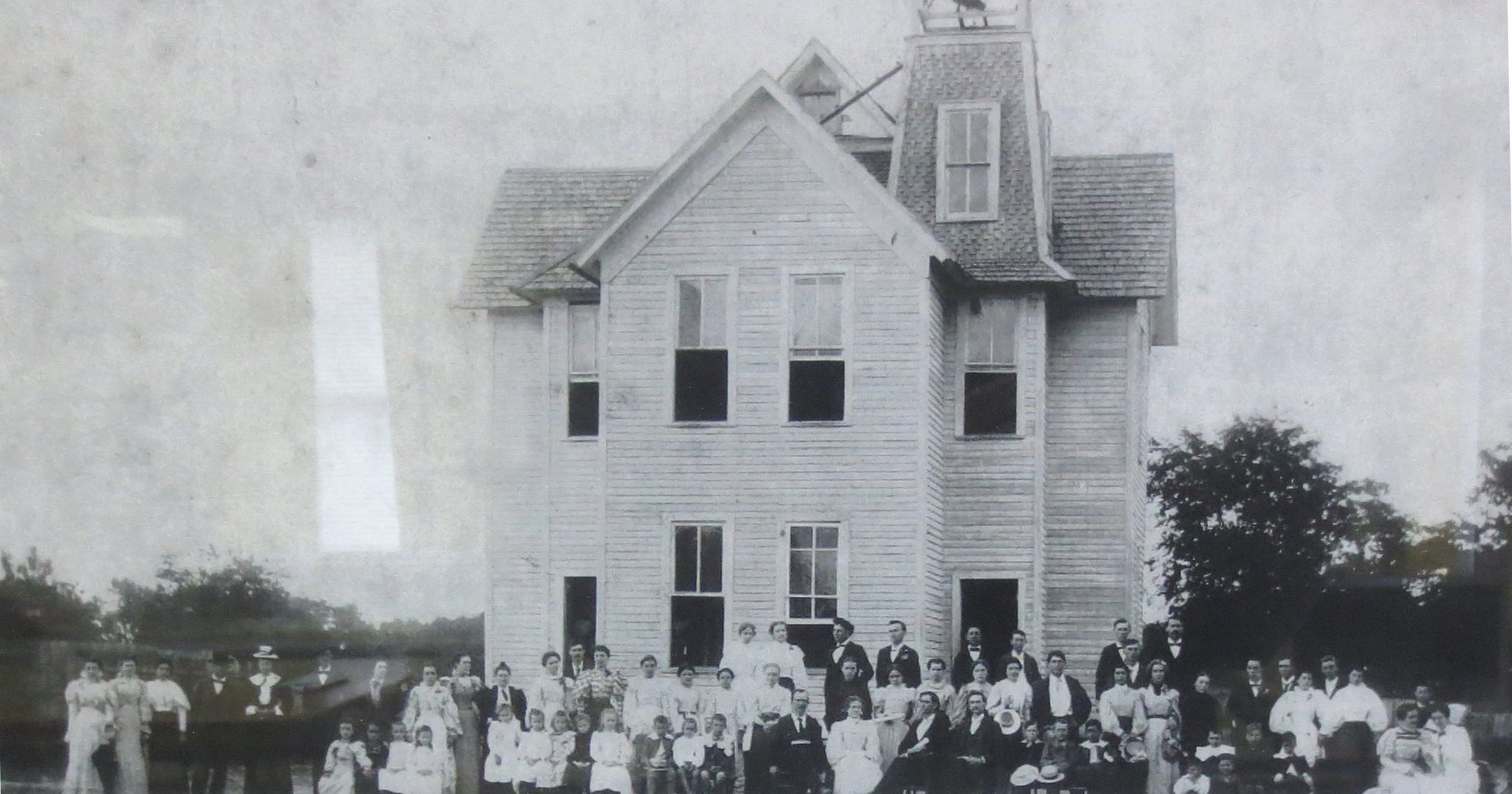
minidaThe citizens in the late 19th century recognized the need for an educational system. So was founded Minida College.

B.S. and B.A. degrees were offered. The fee for a B.S. degree was $8.25 per term for ten weeks and $10.00 per term for a B.A. The school was in session until the building was condemned. Land was purchased and the new school was built on accommodate more students and an expanded curriculum.

In the concluding portion of the Minida Normal College catalogue printed in 1891, are found these words:

“We live in a progressive age.  The world is moving with rapid strides.  No one without proper preparation should expect to keep pace with the times.  The time has been when this country was new and men could be sufficiently educated in the forest.  When they could plod along almost any way and rise with the country.  But that dispensation is passed.  This country is rich and powerful.  Business, science, and literature progress almost with lightning speed, and the man who has to drive his way through this country without an education has to labor under a great disadvantage.”

Click Here to Read the Entire Minida Normal College Catalog

Board of Reference:

John Moran, Dresden, Tenn.
Thomas Little, Dresden, Tenn.
Rev. M. E. Doran, Lynville, Ky.
Hon. A. T. Pullen, Pryorsburg, Ky.
B. N. Pullen, Farmington, Ky.
J. A. Tomilinson, Conant, Florida
J. A. Rateree, Mouth Sandy, Tenn.
Hon. W. W. Ayers, Hico, Ky.
Eld. Richard Fulkerson, Golconda, Ill.
Eld. T. H. Pettit, Arlington, Ky.
Eld. S. F. Cayce, Martin, Tenn.
W. S. Tomilinson ,Danville, Tenn
Hon. Henry George, Wingo, Ky.
Dr. W. C. Wrather, Coldwater, Ky.
Dr. W. B. Stokes, Coldwater, Ky.
W. T. Clark, Dawson, Ky.

Board of Officers and Faculty

A. M. Kirkland, President Faculty and Principal Collegiate Department
J. A. Howard, President Board of Trustees and Principal of Normal Department
J. V. Kirkland, Vice President Board of Trustees and General Manager
G. T. Mayo, Secretary
D. A. McWherter, Treasurer

The Will of Smith Palmer

A scan of the original Smith Palmer will is here. Below is the text.

Will of Smith Palmer, pp. 195-197

In the name of God Amen. I Smith Palmer of Weakley County and State of Tennessee being of perfect mind and memory thanks be given unto God calling to mind the mortality of my body and knowing that it is appointed for all men once to die do make and ordain this to be my last will and testament and as touching such worldly estate wherewith it has pleased God to bless me in this life I give divise and dispose of the same in the following manner and form:

-Item first, as I have heretofore given to William A. Palmer my eldest son to the amount of one thousand and seventy dollars. And to James A. Palmer my second son one Negro man named Gilbert valued at one thousand dollars and a certain tract of one hundred acres of land valued at three hundred dollars.

And to Emily M. A. Cavett my eldest daughter one Negro girl named Margaret vauled at seven hundred dollars and one Negro boy named Doctor valued at six hundred dollars.

Item 2nd As the above named William A. Palmer, James A. Palmer and Emily M. A. Cavitt have received each of them the above named sums I now proceed to give and bequeath John w. Palmer my third son Henry 0. Palmer my fourth son, Mary R. Palmer my second daughter, Elizabeth C. Palmer my third daughter all these last four jointly and severally the number of eight Negroes viz. I give unto John W. Palmer, Henry O. Palmer, Mary R. Palmer, and Elizabeth C. Palmer Reuben, Isham, Henderson, Manuel, Ralph, Ailsey, Ann and Reeny which last mentioned eight Negroes to be equally divided between John W. Palmer, Henry O. Palmer, Mary B. Palmer and Elizabeth C. Palmer as each become of age.

Item 3rd I also give and bequeath unto James A. Palmer, Emily M. A. Cavett (p. 196) John W. Palmer, Henry 0. Palmer, Mary R. Palmer and Elizabeth c. Palmer the number of five Negroes viz. Amy. Guida, Willis, Thomas and Jim jointly and severally to be equally divided among them after my decease.

Item 4th I give and bequeath unto my beloved wife Elizabeth Palmer and Amanda M. F. Palmer, Tennessee Palmer, Virginia Palmer and Edward H. Palmer a certain number of Negroes viz. Nick, Nancy, Wat, Charles, Washington, Susan, Phil, and Isaac to be jointly and severally and equally divided between Elizabeth Palmer my beloved wife and Amanda M. F. Palmer, Virginia Palmer, Tennessee Palmer and Edward H. Palmer.

Item 5 I give and bequeath unto my beloved wife Elizabeth Palmer the manner Negroes viz. Nich, Nancy, Wat, Charles, Washington, Susan, Phil and Isaac to have and to hold the same and the use of them while she Elizabeth Palmer my beloved wife remain a widow.

Item 6th, I do and it is my wish that all my lands house-hold furniture and perishable property shall be sold after my decease and the money equally divided between Elizabeth Palmer my beloved wife, James A. Palmer, William A. Palmer, Emily M. A. Cavett, John W. Palmer, Henry o. Palmer, Mary B. Palmer, Elizabeth c. Palmer, Amanda M. R. Palmer, Virginia Palmer, Tennessee Palmer and Edward H. Palmer.

Item 7th It is my wish that John w. Palmer shall act and be executor ofmy estate and lt is further my wish that the court do not demand any bond and security from the said John W. Palmer for the same. It further my wish that John w. Palmer my executor should sell all my lands either publicly or privately on a credit of one two and (p. 197)_three years and all my perishable property and household furniture and to be sold at public sale on a twelve months credit.

Item 8th It is my wish that Leonard s. Langley shall take care of my daughter Mary R. Palmer ad act as guardian for her. Also for Paul Palmer to take my daughter Elizabeth C. Palmer and act as guardian for her.

And I the said Smith Palmer do hereby utterly disallow revoke and annul all and every other former testament and will legacies bequests and executors by me in any wise before named willed and bequeathed rectifying and confirming this and no other to be my last will and testament. In witness whereof I have hereunto set my hand and seal this sixth day of September in the year of our Lord ·one thousand eight hundred and thirty nine.

Smith Palmer (Seal)

Signed, sealed, published, pronounced and declared by the said Smith Palmer as his last will and testament in the presence of us who in his presence and in the presence of each other have herewith subscribed our names.

George W. McWhorter

Hiram Jones

James Brann


State of Tennessee

Weakley County April Term 1840

This was the execution of the foregoing last will and testament of Smith Palmer proven in open court by the oaths of George w. McWhorter, Hiram Jones and James Brann subscribing witnesses thereunto and ordered to be recorded.

John C. Dodds, Jr. Clerk
Trail of Tears Passes Through Palmersville

by David Webb

[In western Tennessee], the Trail of Tears came through what is now the Nathan Bedford Forrest State Park. From there the Benge Route passed through Henry County along Reynoldsburg Road, to Market Street, turning west onto Rison Street, and then westward on Jones Bend Road to Palmersville [and then on to cross the Mississippi River at Columbus-Belmont State Park].

click to see a larger version

The Trail of Tears was actually four main routes from Virginia, North Carolina, Georgia, Alabama, and Tennessee to Indian Territory (Oklahoma). One of these was a water route that passed Henry County along the Tennessee River and a land route came across the county and through downtown Paris [and then on through Palmersville].

The Benge Route is named for the Cherokee conductor of a 60-wagon train of 1,132 Cherokee and their African-American slaves who departed Fort Payne, Alabama, on September 28, 1838, and who arrived in Indian Territory by January 17, 1839. There were 33 deaths and 3 births along this trail.

Andrew Jackson called for the relocation of all Native Americans east of the Mississippi River in his inaugural address in 1829. His message became federal law with the passage of the Indian Removal Act in 1830.

After gold was discovered in Dahlonega, Georgia, the governor allowed a minority group of Cherokee led by Major John Ridge and Elias Boudinol to gather at New Echota. On December 29, 1835, the Treaty of New Echota ceded Cherokee territory in Tennessee, Alabama, and Georgia to the federal government for $5 million and joint interest in Indian Territory (Oklahoma). The U.S. Senate ratified the Treaty of New Echota on May 23, 1836, by a single vote.

In 1838, the Cherokee and other Native American tribes exhausted all legal challenges to the Indian Removal Act.

Principal Chief John Ross failed to persuade President Martin Van Buren to change the removal policy instigated by Andrew Jackson. Brig. Gen. Winfield Scott was placed in charge of removal of the Cherokee in 1838. Approximately 17,000 Cherokee resisted, and Gen. Scott ordered their forced relocation.

Under Gen. Scott’s command, 7,000 soldiers of the U.S. Army and the state militia spread throughout the Cherokee Nation and drove men, women, and children out of their houses at gunpoint and placed in disease-ridden camps with limited food and supplies. Private John Burnett recalled: “I saw the helpless Cherokees arrested and dragged from their homes, and driven at the bayonet into the stockades.”

Gen. Scott ordered soldiers to build stockade forts to confine Native Americans in preparation for their journey westward. One of these internment camps, Fort Payne, Alabama, was built by Captain John Payne and 22 of his soldiers and completed by April, 1838. By July, there were over 800 Cherokee confined at the fort.

Continue reading

Lessons Learned from a Palmersville Legend

By Nelda Rachels (first published in Hometown magazine)

In 1975, I was fortunate to move to Palmersville, just up the hill from Opal Mayo and her husband, Irvin.

Soon, I was pulling my two young children in their little red Flyer down the road to her farmhouse for occasional visits.  Mr. Mayo would die soon after this, but I would get to know well “Mrs. Opal,” a woman of near legendary proportions, who lived in or near the Palmersville community from 1906 to 1987.  It was at her home that I learned the lessons of hospitality, frugality, and piety, which were hallmarks of her character.

Like most women of her generation, she immediately wanted to ply my children and I with food or drink the moment we entered her home.  She would have, proverbially speaking, killed the fatted calf to fulfill her notion of hospitality.  However, there was never any need for such extreme measures because her larder was always full.  So one of the first lessons she taught (and the hardest to learn) was to prepare ahead for visitors.  I learned that everything she’d prepared had been made in the time-honored fashion (by scratch) and that she often made her pies, cookies, and cakes in multiples so that not a bit of oven heat would be wasted.

That frugality, to utilize every kilowatt, may be the most legendary aspect of her character and perhaps the one I most admire in this age of excess.  The old adage, “Use it up, wear it out, make it do, or do without,” was her life’s motto.  I think because she’d grown up during hard times, she knew that what you had today could be gone tomorrow.  I remember the day she dug up some of her Red Emperor tulip bulbs to share with me.  She saw me looking at her shovel, its edge worn away to resemble the eastern border of Tennessee.

“Maybe you think I need a new one,” she said, laughing.  “Irvin used it settin’ trees while he was in the CCC during the Depression, but it’s not so worn out that it can’t dig up a few tulips yet.”

Mrs. Opal’s piety was also legendary.  She attended the Palmersville Church of Christ and never missed a service that I remember.  Even when she was actually “unable” to drive, she drove to church anyway, too independent and strong-willed to ask anyone for a lift.  And despite a lifetime of listening to sermons, I think she rarely let her mind wander because she always took notes on every sermon in a  tenographer’s notepad.  In addition, she never engaged in gossip, read her Bible “religiously,” and filled a large block calendar with information as to meeting times, preachers, and VBS dates.

Those yearly calendars also held information as to visitors, events, and weather.  Once, I glimpsed a stack of yellowing calendars in an upstairs room.  I’m sure one of them held information about the Dust Bowl years, the time when she bought one of her few cans of “store-boughten” corn.

I guess I was a bit disappointed when no auction was held after Mrs. Opal’s death.  I only wanted to bid on that shovel, which, for me, most represented Mrs. Opal’s history and character.  I’d be tempted to hang it near my mantel as a testament to her life. However, I think she’d be more pleased if I used it. No doubt, she’d say there is life in that old shovel yet.

Obion River and More

Our quarterly meeting was held Friday night, July 31, 2015 at 7:00 pm at our building. Dr. Hugh Berryman was the guest speaker for the program. He spoke about the geological makeup around the Palmersville area.

On Saturday August 1st, the Historical Society sponsored another “Canoe Float down the North Fork of the Obion River.” We met at the parking lot of the Historical Society building at 10:00 a.m. and then departed to the Sprouts Levee bridge for departure at 10:30 and floated to the Latham bridge. We had some additional information about the history of this section of the river including the swamp, logging, sawmilling, shingle making, old cypress hole, and the Byars-Bowlin-Watts water mill. Also the foundation of a third large building of the Lochridge Mill complex has been exposed by recent floods.

Cleaning of the historic portraits of early Palmersville area citizens who were members of the Masonic Lodge from the 1870s and onward is finished. Reframing with acid-free materials will soon be completed. We are grateful to the Lodge members for giving us the opportunity to preserve these portraits.

Recent Deaths of Palmersville graduates:

  • Anna Faye (Harrison) Hargrove, class of 1958
  • Jimmy Dale Puckett, class of 1962
  • Kerry L. Pentecost, class of 1969

Baseball after the War

Jim Cantrell submits this look back at community baseball in P’ville —

Between the late eighteen hundreds and the mid-nineteen sixties baseball was truly the American pastime. This was true in the Palmersville area, with many small communities having their own baseball team. During World War II these activities were no longer possible.

After the war teams were again organized in several communities. The make-up of the Palmersville team consisted mostly of players of the thirties and players of the late forties, with the occasional players from the twenties being available to pinch-hit.

In l947 Kuron Hooks and his wife Bernice had opened a general store with lunch counter in the old Willis Lee saloon building. Kuron had been a star catcher and heavy hitter on a team in some county South of Weakley County and wanted Palmersville to have a community team. We soon had a good local team and played teams organized at various times in Cuba, Ky., Dukedom, Latham, Dresden, Gleason, Huntingdon, Cottage Grove, Liberty, Midway, Skull Bone —— etc.

Kuron was our very capable catcher, with Ben Cantrell beginning to develop in the late forties and early fifties; later he was a catcher on Bethel College’s team. Keg Dawson was our star pitcher. He was in his mid thirties at the time and before World War II probably the best pitcher in Weakley County. Ruben Grubbs and Willy Griffith were also in their mid-thirties, very good pitchers, and were used in most of our games. Continue reading

Palmer Family Service Record

Ed Palmer
Company E. Enlisted September 17, 1863 at Paris, TN, by Capt. Bomer for 3 years. Bay horse valued at $600. Present on roll for March/April 1864. On roll for May/June 1864, “Transferred to old command May 23, 1864”.
Source: Compiled Service Records

E.H. Palmer
Company K. Enlisted January 1, 1864 at Conyersville, TN, by Capt. Bowman for the war. Black mule valued at $600. Present on roll for March/April 1864 as Private. Present on roll for May/June 1864 as 1st Sergeant, “Elected May 20th”. Wounded at Harrisburg.
Rennolds (1904/61) reports he died in hospital.
Died at Lauderdale Springs Confederate Hospital, September 12, 1864.
Source: Compiled Service Records [R]; Rennolds (1904/61); Watkins (1989), p. 30.

J.T. Palmer
Greer’s Regiment. Although filed with the Greer’s regiment cards, the labels appear to read “Green’s” regiment. On prisoner rolls: private, Co. A, captured at Waverly, TN, June 14, 1862; at Camp Douglas, IL, February, 1863; transferred to City Point, VA, April 1863.
Source: Compiled Service Records [G]

James Palmer
Company E. Enlisted November 25, 1863 at Paris, TN, by Capt. Bomer or Captain Hallum for 3 years. Bay mare valued at $600. Present on roll for March/April 1864. On roll for May/June 1864, “Transferred to old command May 23, 1864”. The file also contains a card stating that James Palmer was “wounded slightly left arm” at Tishomingo Creek; this card probably is misfiled.
Source: Compiled Service Records

Jesse Washington Palmer
Company E. The Index to Tennessee Confederate Pension Applications shows that Tennessee pension application #10669 was filed by Jesse W. Palmer of Carroll County for service with the 20th Cavalry.
Born 1844, Henry Co. TN. Married 1867, Martha Jane Ross, in Carroll Co. TN. Died 1920, Carroll Co. TN. Widow’s pension file #8015.
Source: Index to Tennessee Confederate Pension Applications; Sherril (1992)

Joseph Martin Palmer
Company E. Enlisted September 17, 1863 at Paris, TN, by Capt. Bomer for 3 years. Bay horse valued at $750. Present on roll for March/April 1864 as 2nd Sergeant. Present on roll for May/June 1864 as 2nd Sergeant. Wounded at Harrisburg. Oath of allegiance at Nashville, TN, May 23, 1865; described as resident of Henry Co., TN, fair complexion, light hair, blue eyes, 5 ft. 11 in., surrendered at Johnsonville, TN, May 20, 1865.
On report of absentees and deserters, Verona MS, Feb. 28, 1865. Residence Henry Co. TN; probable whereabouts Henry Co.
Born 1836, Henry Co. TN. Married 1855, Martha J. Faust, in Henry Co. TN. Died 1896, Gibson Co. TN. Widow’s pension file #4402.
Source: Compiled Service Records [R,C]; Sherril (1992); David Dyer

J.M. Palmer
Company E. Enlisted September 17, 1863 at Paris, TN, by Capt. Bomer for 3 years. Absent on roll for March/April 1864, “Absent with leave April 2, 1864”. Absent on roll for May/June 1864, “Absent without leave in Tenn. By Hallum”.
Source: Compiled Service Records [R]

from: http://www.utm.edu/staff/leeb/service.htm