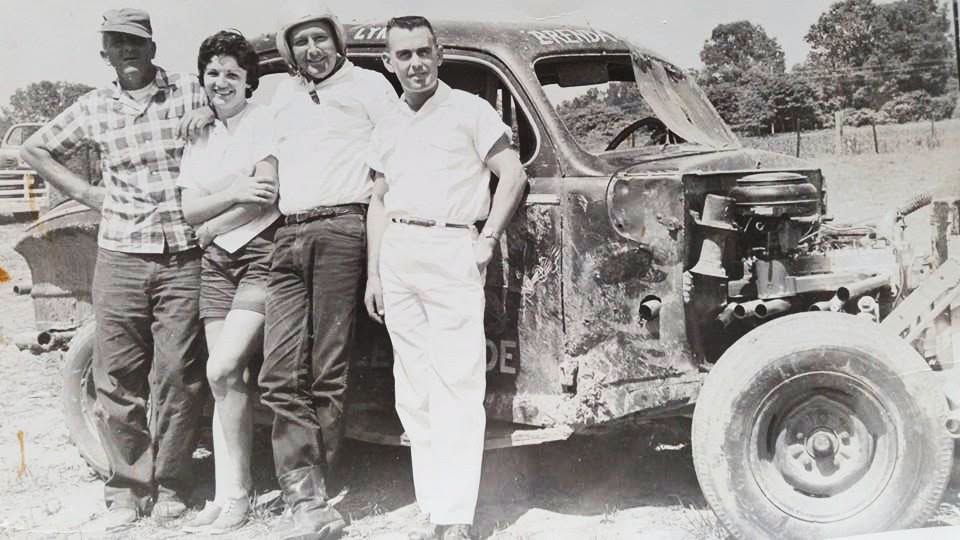
Mayfield, KY c. 1963
Stock car racing in Kentucky — Pictured are (L to R) Palmersville’s Wayne Puckett, Brenda (Puckett) Donoho, Doyle Turberville and Howard Mitchell standing in front Ole Clyde.
Photograph courtesy of Carol Ann (Watkins) Smith.
Mayfield, KY c. 1963
Stock car racing in Kentucky — Pictured are (L to R) Palmersville’s Wayne Puckett, Brenda (Puckett) Donoho, Doyle Turberville and Howard Mitchell standing in front Ole Clyde.
Photograph courtesy of Carol Ann (Watkins) Smith.
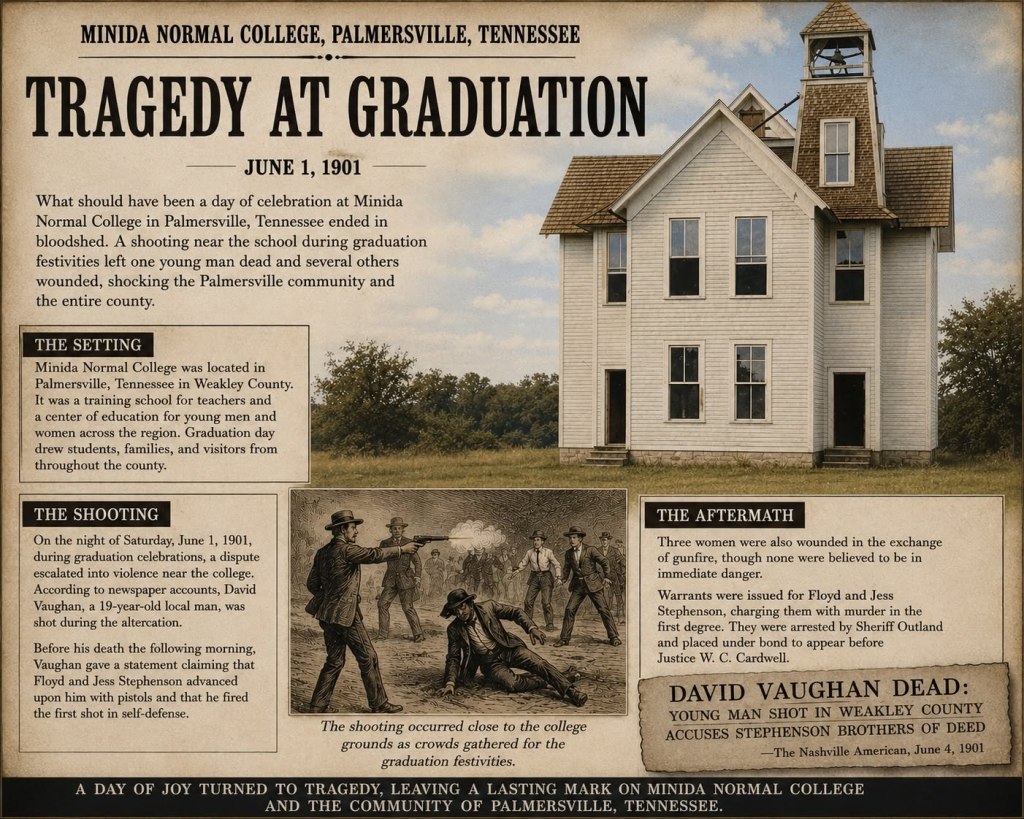
Palmersville, Tennessee – June 1901
What should have been a day of celebration at Minida Normal College near Palmersville became one of the most tragic events recorded in the community’s early history.
On the night of June 1, 1901, as students, families, and visitors gathered for graduation exercises at the college, a shooting erupted near the school grounds. The disturbance shattered the festive atmosphere surrounding commencement and quickly became the subject of newspaper reports across Tennessee.
According to The Nashville American of June 4, 1901, 19-year-old David Vaughan received fatal wounds during the altercation and died the following morning.
Before his death, Vaughan reportedly gave a statement concerning the circumstances that led to the shooting. He claimed Floyd and Jess Stephenson had advanced upon him with pistols and that he fired the first shot in self-defense.
Following Vaughan’s death, warrants charging the Stephenson brothers with first-degree murder were issued by local authorities.
Newspaper reports stated that three women were also wounded during the exchange of gunfire, although none of their injuries were believed to be fatal. [For information about one of the wounded, see this article.]
Sheriff Outland arrested the Stephenson brothers and placed them under bond pending a hearing before Justice W. C. Cardwell.
The shooting occurred during one of the most important events of the school year. Founded in the late nineteenth century, Minida Normal College was a respected educational institution in Palmersville that attracted students from Weakley County and neighboring communities.
Graduation day traditionally brought large crowds to the campus, making the tragedy even more shocking to those in attendance.
News of the shooting spread rapidly throughout Weakley County and beyond, transforming what should have been a memorable commencement celebration into a somber chapter in Palmersville’s history.
More than a century later, the incident remains one of the most notable events ever associated with Minida Normal College and serves as a reminder of a tragic day when graduation festivities ended in violence.
Compiled from an article in the Nashville American in 1901.
By Robert G Reynolds of Weakley County History
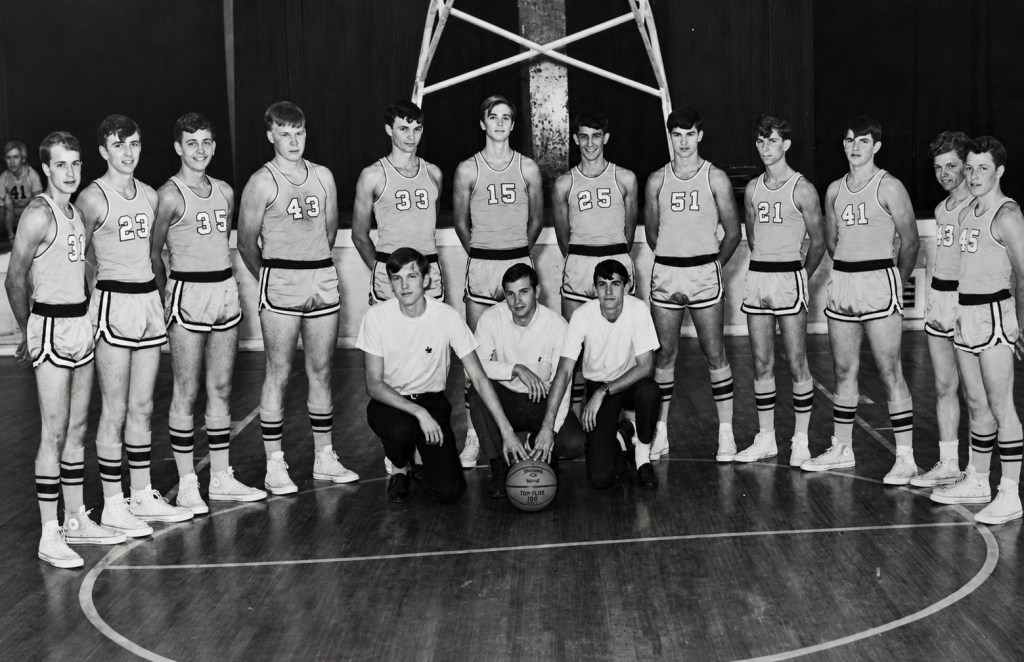
Players listed (left to right):
Many thanks to Robert G Reynolds of Palmersville TN News
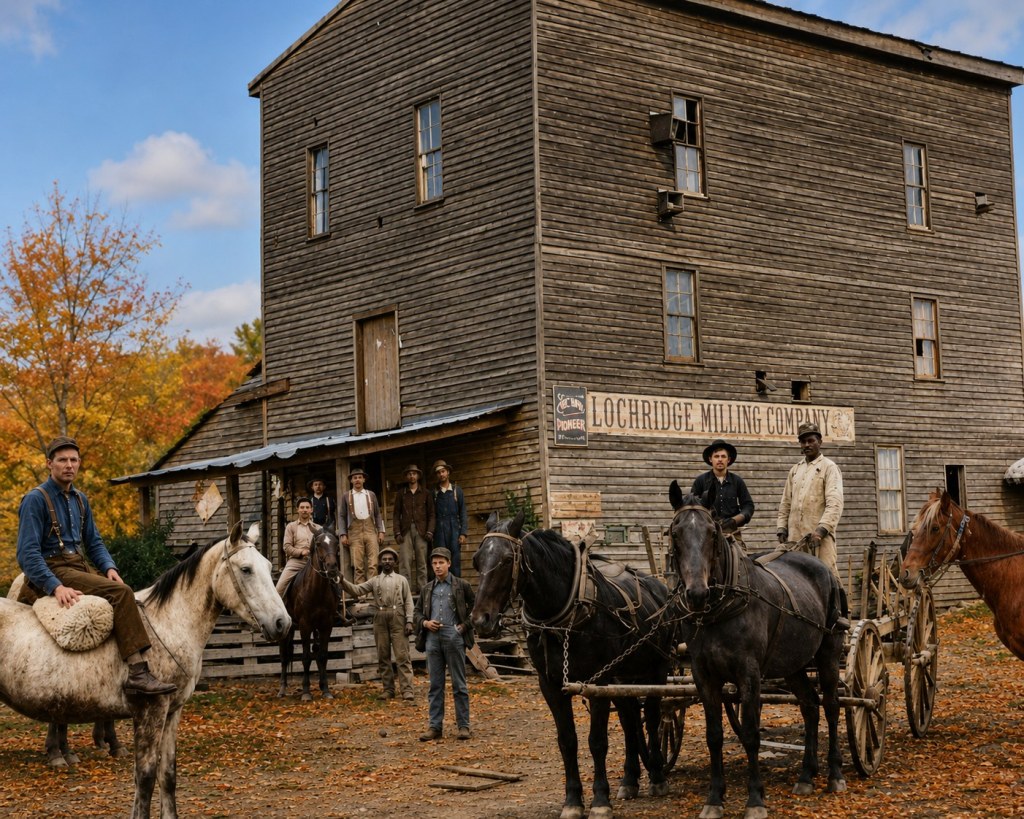
Historic Lochridge Mill Served the Latham–Palmersville Community.
By the closing years of the 1800s, long before paved highways and modern farm equipment reached rural Weakley County, one of the most important gathering places between Latham and Palmersville was the old Lochridge Mill, sometimes referred to historically as Lockridge Mill.
Situated along the North Fork of the Obion River (before the new river was dug in 1910-1912) in the countryside east of Latham, the mill served generations of farm families during the late 1800s and early 1900s.
More than simply a place to grind corn and grain, Lochridge Mill stood at the center of rural life. In an era when nearly every family depended on farming, local gristmills were essential.
Farmers hauled wagonloads of corn and wheat to be ground into meal and flour, often waiting their turn while exchanging news, discussing crops, and visiting with neighbors. Like many Tennessee mills of the period, Lochridge Mill became both an economic and social hub for the surrounding countryside.
A rare early photograph from around 1900 shows the Lochridge Grist Mill east of Latham, with local resident Les Carney seen horseback (man on horse to the left) near the structure, offering a valuable glimpse into community life during the mill’s operating years.
The mill’s history reaches even further back into the 19th century. During the turbulent days of the Civil War, the location became known across the region through the Skirmish at Lockridge Mill, fought in May 1862 near the ford and mill owned by Marshall Lochridge. Confederate cavalry surprised Union troops near the crossing, making the mill site a small but notable battlefield in Weakley County history. The encounter left the Lockridge Mill name permanently tied to local historical memory.
Following the war, Lochridge Mill continued serving agricultural families as Weakley County rebuilt and prospered. The North Fork of the Obion River provided the waterpower that turned the millstones, a dependable source of energy before electricity and gasoline engines became common.
Mills such as Lochridge helped sustain isolated farming communities where travel to larger towns could take hours by wagon. Weakley County’s agricultural economy during the 19th century relied heavily upon such locally powered industries.
By the early 20th century, however, rural life began changing.
Steam-powered and later gasoline-powered mills, improved roads, and larger commercial operations gradually reduced the need for small water-powered gristmills. Communities like Latham evolved, and many of the old mills slowly disappeared from the landscape. Nearby Latham itself once supported mills and businesses that served the farming community, reflecting the importance of such enterprises in local development.
Today, Lochridge Mill no longer stands as it once did beside the waters of the Obion, yet its legacy remains an important chapter of Weakley County history. For many families between Latham and Palmersville, the old mill represented hard work, self-sufficiency, and neighborly fellowship — a reminder of a time when the turning of a waterwheel helped sustain an entire rural community.
Colorized historic mill photograph by Weakley County History
Information compiled by Robert G Reynolds of Weakely County History
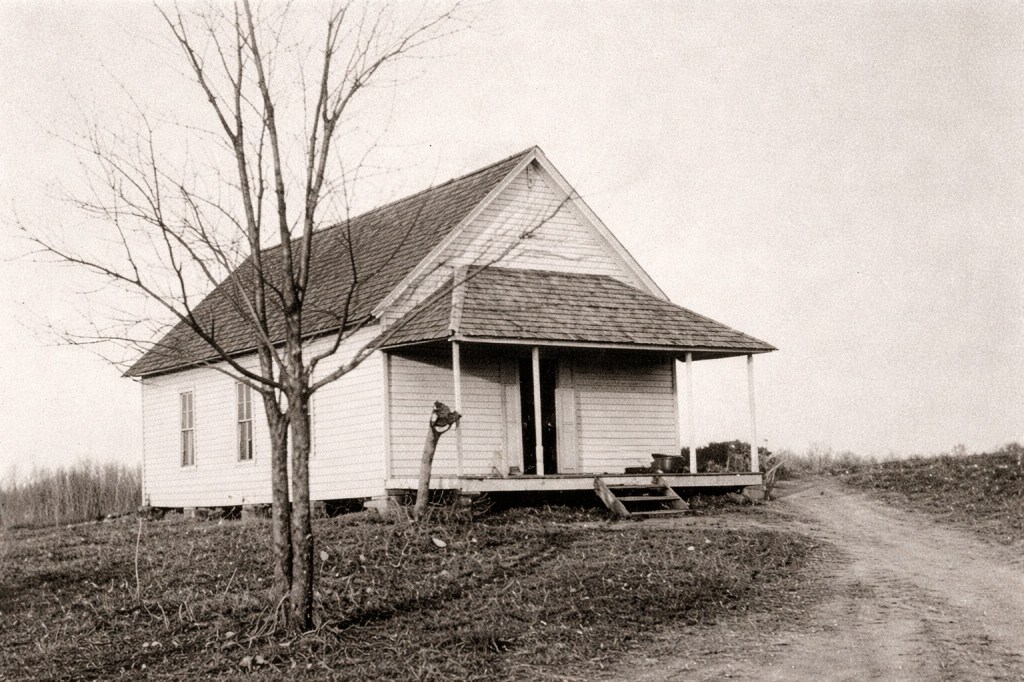
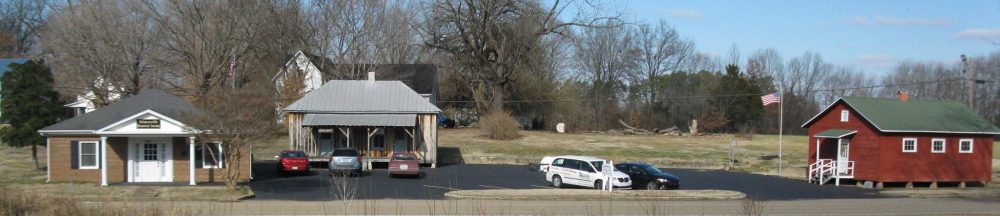
Pictured is Donoho School, which was located in the 1st District at the junction of Donoho Levee Rd, Workman’s Cemetery Rd (or was it Glover Rd?), and Austin Springs Rd.
The school was built c. 1910 on land donated by Augustas Donoho. Teachers who held positions were Eula Aniley during 1935, Florence Mae Donoho during the later part of the 1930s, and Gurtrude Moore until the school’s closing in 1940.
The photo and part of information are courtesy of Janice (Donoho) Laws.
You can see a picture of the 1939/40 Donoho School students here.
Special thanks to Robert G Reynolds of Palmersville, TN News
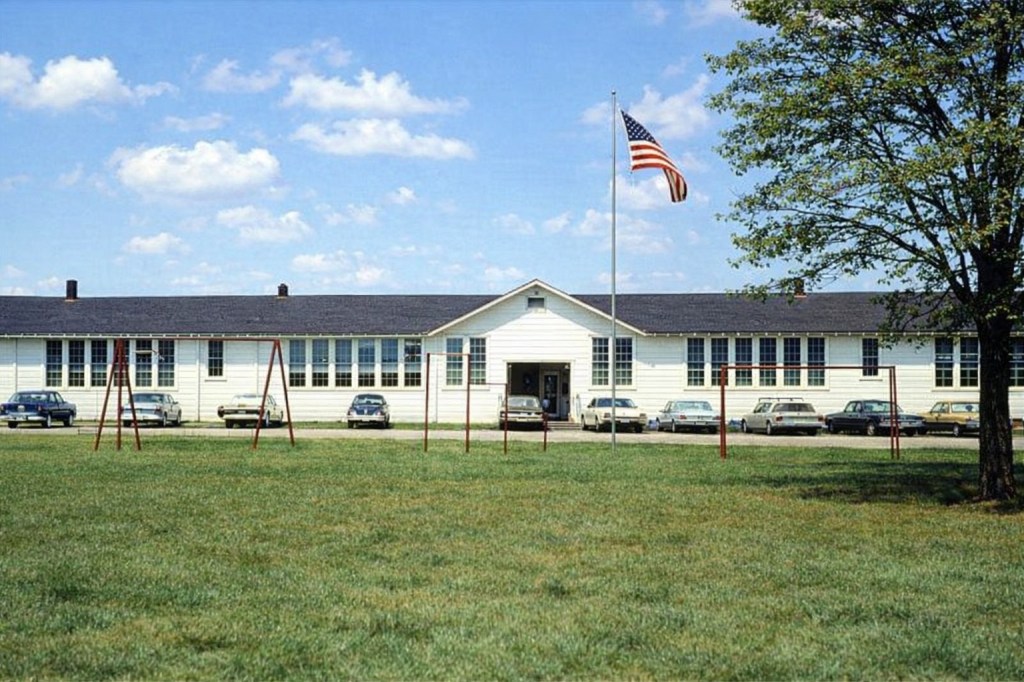
Constructed in 1921 at the cost of $10,000, with two wings added in 1939, the building served 1st through the 12th grades.
During the late ca1930s, a separate building was constructed behind the school for Agriculture classes and a shop. In 1950 the largest gymnasium in Weakley County was built on the property, along with two classrooms and a lunch room, later a one room separate building was constructed for the 4th and 5th grade classes.
In 1980/81, the building shown here was demolished and replaced by a new modern school building serving grades K through 12. For the next 17 years the school operated as full service public school offering classes for students in grades K through 12.
In 1997 the high school or grades 9 through 12 were moved to the Dresden High School system. Palmersville school would operate as a grade K through 8 school for the next 6 years until state funding would no longer support the expense of operating a school in Palmersville.
For 82 years the community of Palmersville offered public school for all that lived within the Palmersville school zone or district.
For those students who attended Palmersville School during any of it’s 82 years of service; most can close their eyes at night and walk its halls by memory, walk through each class room, remembering classmates, teachers and events that shaped their lives, the school that made them part of who they are today.
(restored, photo courtesy of the 1970 yearbook)
By: Robert G Reynolds
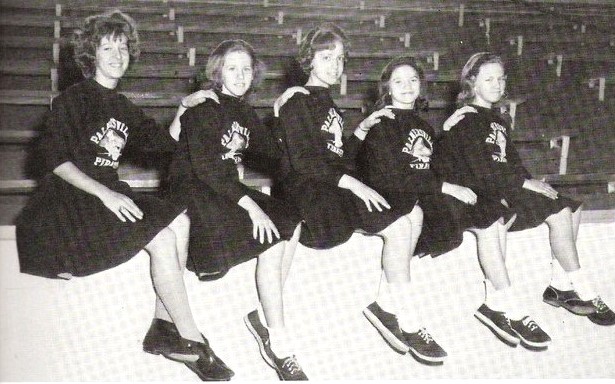
Pictured are L-R: Westbrooks, Chambers, Owens, Watkins and Woodruff.
Special thanks to Robert G Reynolds, Palmersville, TN News
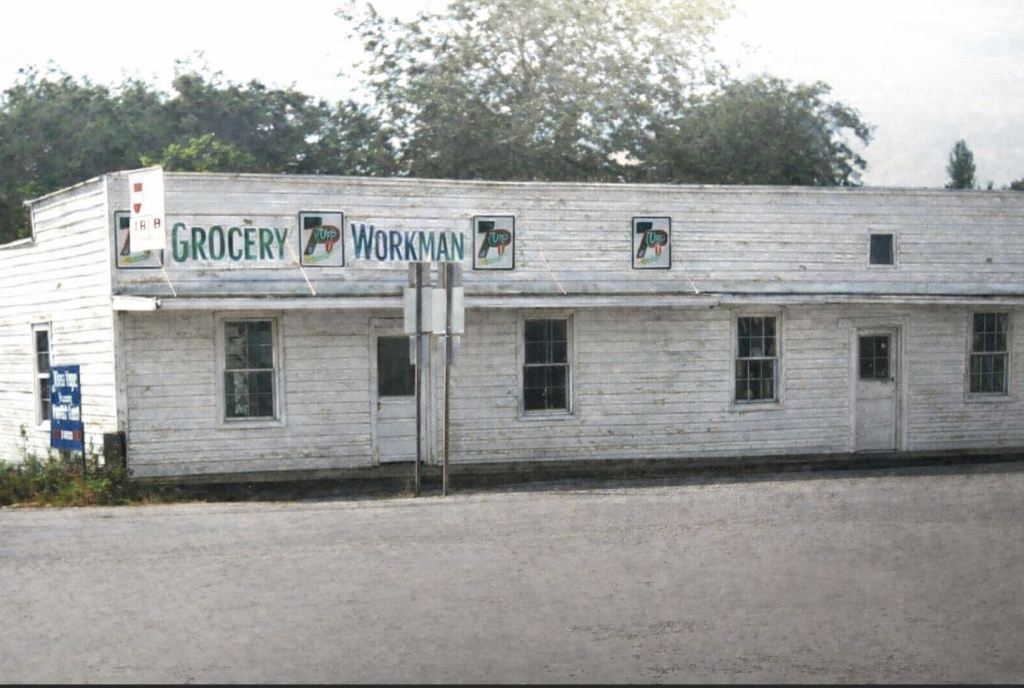
Workman’s Grocery was located in the heart of downtown Palmersville, on the lot currently hosting the Palmersville Fire Department.
Owned by Carmon and Eva Workman; the left side of the building was used for the grocery and the right was the location of an upholstery shop, which we believe was operated by Mrs. Eva during the early years.
Workman Grocery, or Carmon’s, as many referred to the store, carried a variety of groceries and hardware such as milk, bread, sandwich meats even nails and hunting supplies.
Carmon’s, was a gathering place for locals, who gathered on winter days around the pot-bellied stove that stood in the center of the store, where patrons (old men) exchanged stories of summer garden crops and tales who caught the biggest fish or who grew the biggest watermelon that previous summer.
It is unknown exactly when Workman’s Grocery closed for business. Carmon and Eva Workman both passed during the early 1990s leaving behind a legacy of an invaluable contribution to the community and having build a successful Palmersville business through years of hard work and determination.
Story By (and special thanks to): Robert G Reynolds, Palmersville, TN News

Shown is West Tennessee’s first cheese factory, located on the left hand side of the Palmersville School driveway loop. The factory was built close to 1923, the Nashville Tennessean newspaper wrote that the factory would be on display at the Palmersville Fair during that same year.
During 1933 the Tennessean again published a story telling that Bates Pentecost, who was Pres of the milk organization, had announced of an upcoming expansion plan for the factory, we assume he was referring to the addition seen on the left of the building in this rare 1939 photograph found in Atlanta Ga at the National Archives.
It is unknown when the factory stopped producing cheese but it had been a great benefit for local farmers who sold milk to the factory for years to produce grade A cheese.
The cheese factory’s dilapidated building remained on the school loop until the 1970s, efforts to save it for historical purpose failed because of its poor condition.
(photo courtesy of the US National Archives)
Story By (and special thanks to): Robert G Reynolds, Palmersville, TN News

Here are the senior girls basketball players for the 1978-79 season.
L-R: Sheila Gatewood, Stacie Fagan, Julie Welch and Teresa Crittendon
Thanks to Glenn Reynolds at Palmersville TN News.

