by Nelda Rachels
A town never dies as long as there are people who remember it, and people who are willing to record and read about those memories. Vivian Rickman, a Palmersville resident, remembers her visits to Austin Springs back when it was still a thriving community.
When Mrs. Rickman was a child, tourists were no longer coming for the healing effects of the mineral spring, but locals still went there to shop. Mrs. Rickman says that going to the larger and farther away town of Dresden was a real treat, which usually only happened when relative Charlie Stephenson took her and her family in his Model T. Since she lived at Fairview, only about five miles from Austin Springs, it was closer to go there in the family wagon.
George Harris owned one of the two general mercantile stores popular during Mrs. Rickman’s day. The Johnson brothers, Clyde and Chap owned the other. A 1931 article written by local correspondent Ela Frields mentions the Harris Brothers laying the foundation for a general merchandise store. Residents remember it as being the larger of the two stores. Mrs. Rickman liked buying a soda pop for five cents or buying clothes in the Harris store. One year, her parents bought her a fur coat with shiny brass buttons. Sometimes the family would walk on the boardwalk over to Sam Dudley’s place to buy some healing salve.
Howard Harris, former postmaster at Dukedom and a relative of the now deceased George Harris, remembers that George had quite a sense of humor. Mr. Harris told me this story: One day, a woman sent her child to George’s store to buy some sugar. The sugar was in a barrel, so some had to be scooped out, weighed, and packaged. As a joke, Harris packaged sand instead of sugar and sent it home by way of the child. Later, the woman came back in with her “sugar” and stated that she had decided she didn’t want any sugar after all. And before George could stop her, she had dumped her package of sand back into his barrel of sugar. The joke was on him! Mr. Harris told other delightful tales on George. It must have been a fun place to shop. No wonder Mrs. Rickman liked to go there.
Ela Frields reported in a February 3, 1931 article in the Dresden Enterprise and Sharon Tribune that the Johnson General Store had been burglarized on the previous Sunday. The thieves had stolen overalls, shirts, cigars, cigarettes, cheese, and money. In this same article, Mrs. Frields reported that the old Austin Springs Hotel (mentioned in the last article) built “some forty years” before had burned down due to a kitchen flue fire. By this time, tourists were no longer using the hotel as a place to stay. The campground near the Springs, too, was no longer in use. Instead, the hotel had been converted into a dwelling. Luckily, the then current residents Dewey Ainley and family escaped and were later installed in Mrs. Lottie Cantrell’s tenant house. Howard Harris remembers watching the hotel burn from a window of his home when he was just five years old.
There continued to be stores and businesses after the hotel’s burning. Perhaps a “hall of fame” of a few of the former owners and residents should be remembered here. Clarence Berryman, and later, Bant Hall, owned a blacksmith shop. Carey Frields owned a sawmill, Charlie Vincent cut hair in 1946 for twenty-five cents, and George Harris and the Johnson Brothers owned the two mercantiles. There was also a beer-joint, cream station, gristmill, switchboard, and probably several other businesses. There was also a string band consisting of Carey Frields and Charlie Vincent, violinists; Delmas Copeland and Bant Hall, guitarists; and Chap Johnson on harmonica. Other early residents of the area had last names like Acree, Murrell, Austin, McGuire, Bynum, Dunn, Gargis, Farmer, and Stunson.
The Decline of Austin Springs probably began when the last tourist came and put his or her jug down into the spring. After that, the decline was steady. With the advent of cars and the ensuing mobility, small towns could no longer compete with larger nearby towns that had better buying and job opportunities for the public. One by one the stores and businesses dwindled away as the population began traveling away to do their shopping elsewhere. In addition, as Mrs. Rickman said, “The people just faded away and so did the town.”
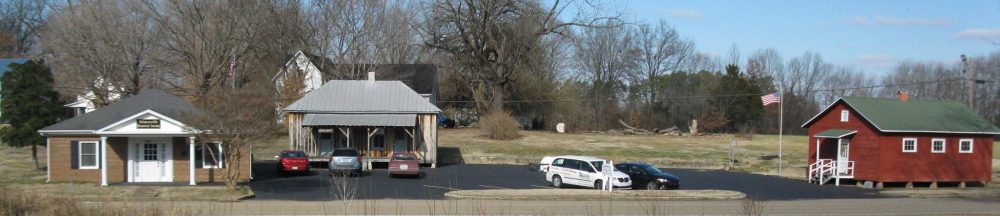
Even the mineral spring is no longer there. It is buried somewhere under the bridge structure nearby. Community members remember that the highway department reworked the road and bridge several years back and covered it up. Some still aren’t happy about that event. Even the road, which cut through the main part of town, is no longer there. Only the trail in tall grass marks the spot where Mrs. Rickman used to walk the boardwalk to Sam Dudley’s place. However, there are still several homes clustered nearby, along with an empty store, built in the sixties. Austin Springs may have declined from what it once was, but it hasn’t fallen. The community still exists in the people who live there and in the memories they share about the past.
from http://www.utm.edu/staff/leeb/Austin%20Springs/Part%20I.htm


 Palmersville Historical Society