A Brief History of Latham

by Nelda Rachels (published formerly in Hometown, 2003)

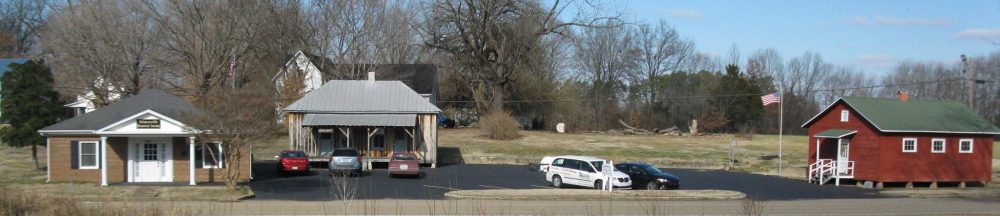
Latham, like many small communities, has moved slightly from its original location in order to serve customers on a rerouted and busier highway.  Fortunately, the town’s main business area only had to move a few hundred yards to a rerouted Highway 118.

However, the greater mobility of the populace, the changes from a predominantly agricultural to an industrial economy, and the volume buying and cheaper prices of chain stores have all but killed the economic base of such communities in recent years.

The economic future looked much brighter in the 1850s when E.P. Latham settled in the area north of Dresden.  By the early 1900s, according to Virginia Vaughan’s text about about Weakley County’s history, Latham had at least two general stores, one owned by R. L. Stevens and another owned around 1919 by Winstead and Jones.  The Winstead and Jones store is said to have “sold everything from coffins to coffee.”  The drug store was run by Sam Winstead, who later managed the entire general store after his father had left the business.

During the 1920s Carlos Brundige operated a gristmill, sawmill, and general store.  Waterpower ran the gristmill while it served the community on the North Fork of the Obion River, but when the mill moved to Latham, it converted to steam power.  In addition there was a blacksmith shop and the early churches of Pisgah Methodist (organized in 1887) and Old Concord Baptist.  Later, the Calvary Missionary Baptist Church and the Church of Christ of Bible Union came to the community.

A small school by the name of Bible Union educated many students until 1955, after which it became a community center.  It was a long white wooden structure with a row of windows down its length.  Unfortunately, this historic building burned during the summer of 1999.  This tangible reminder of the community’s past, like much of any town’s history, now remains only in the memories and recollections of its people.

Life’s Greatest Lesson

By Nelda Rachels

(This story was first published in 2001 as the award-winning essay in Expressions from Home, a publication of the Weakley County Arts & Humanities Council. The essay had to be a very short 250 words, a very difficult assignment indeed! Ruth Rickman passed away just a few years after this essay was written, perhaps about 2004. Everyone misses her.)

My friend Ruth Rickman, who would soon turn ninety-five, needed someone to stay with her while she recuperated from pneumonia. I felt close to her, but I’d begun work on a book, and too much had already interrupted the writing. What if those two requested nights turned into four, five, or a month of nights? However, I knew the thoughts were selfish ones, so I put them away and stayed. I’m glad I did.

I’m afraid I’m a poor caretaker though. The first night I kept her up too late. She loved to talk about the old days, and since I’m a lover of history, I listened, enrapt. A question, such as, “Do you remember what year electricity came to Palmersville?”, netted the answer “1940” and the story of her young son who had died in ’39, how she had sat at his bedside waving a cardboard fan for days, and how it was too bad electricity hadn’t come a year earlier, when an electric fan could have relieved her feverish son.

She also told me the gruesome tale of a local man who had come to her grandfather’s store to buy fresh meat from a hog killed that frigid morning and how he’d left with the meat in his Model T but never made it home. He and his car drove off a levy and into a swamp. When the community searched and found him stiff and frozen near his car, they took his body to his widow’s house where they stood him in a corner to thaw.

Before I left that first morning—late, since we stayed up till 11:00 p.m. talking—she reached for my hand and pressed it with her own, blackened by the needles and tubes of her recent hospital stay. She thanked me for staying and said she loved me. I hugged her ninety-two pound frame. When she kissed me, I wondered why I had ever thought I was too busy to stay with her. Ruth had taught me the most valuable lesson of all: love is everything; take time to show it, for nothing, nothing else at all really matters.

Lessons Learned from a Palmersville Legend

By Nelda Rachels (first published in Hometown magazine)

In 1975, I was fortunate to move to Palmersville, just up the hill from Opal Mayo and her husband, Irvin.

Soon, I was pulling my two young children in their little red Flyer down the road to her farmhouse for occasional visits.  Mr. Mayo would die soon after this, but I would get to know well “Mrs. Opal,” a woman of near legendary proportions, who lived in or near the Palmersville community from 1906 to 1987.  It was at her home that I learned the lessons of hospitality, frugality, and piety, which were hallmarks of her character.

Like most women of her generation, she immediately wanted to ply my children and I with food or drink the moment we entered her home.  She would have, proverbially speaking, killed the fatted calf to fulfill her notion of hospitality.  However, there was never any need for such extreme measures because her larder was always full.  So one of the first lessons she taught (and the hardest to learn) was to prepare ahead for visitors.  I learned that everything she’d prepared had been made in the time-honored fashion (by scratch) and that she often made her pies, cookies, and cakes in multiples so that not a bit of oven heat would be wasted.

That frugality, to utilize every kilowatt, may be the most legendary aspect of her character and perhaps the one I most admire in this age of excess.  The old adage, “Use it up, wear it out, make it do, or do without,” was her life’s motto.  I think because she’d grown up during hard times, she knew that what you had today could be gone tomorrow.  I remember the day she dug up some of her Red Emperor tulip bulbs to share with me.  She saw me looking at her shovel, its edge worn away to resemble the eastern border of Tennessee.

“Maybe you think I need a new one,” she said, laughing.  “Irvin used it settin’ trees while he was in the CCC during the Depression, but it’s not so worn out that it can’t dig up a few tulips yet.”

Mrs. Opal’s piety was also legendary.  She attended the Palmersville Church of Christ and never missed a service that I remember.  Even when she was actually “unable” to drive, she drove to church anyway, too independent and strong-willed to ask anyone for a lift.  And despite a lifetime of listening to sermons, I think she rarely let her mind wander because she always took notes on every sermon in a  tenographer’s notepad.  In addition, she never engaged in gossip, read her Bible “religiously,” and filled a large block calendar with information as to meeting times, preachers, and VBS dates.

Those yearly calendars also held information as to visitors, events, and weather.  Once, I glimpsed a stack of yellowing calendars in an upstairs room.  I’m sure one of them held information about the Dust Bowl years, the time when she bought one of her few cans of “store-boughten” corn.

I guess I was a bit disappointed when no auction was held after Mrs. Opal’s death.  I only wanted to bid on that shovel, which, for me, most represented Mrs. Opal’s history and character.  I’d be tempted to hang it near my mantel as a testament to her life. However, I think she’d be more pleased if I used it. No doubt, she’d say there is life in that old shovel yet.

Baseball after the War

Jim Cantrell submits this look back at community baseball in P’ville —

Between the late eighteen hundreds and the mid-nineteen sixties baseball was truly the American pastime. This was true in the Palmersville area, with many small communities having their own baseball team. During World War II these activities were no longer possible.

After the war teams were again organized in several communities. The make-up of the Palmersville team consisted mostly of players of the thirties and players of the late forties, with the occasional players from the twenties being available to pinch-hit.

In l947 Kuron Hooks and his wife Bernice had opened a general store with lunch counter in the old Willis Lee saloon building. Kuron had been a star catcher and heavy hitter on a team in some county South of Weakley County and wanted Palmersville to have a community team. We soon had a good local team and played teams organized at various times in Cuba, Ky., Dukedom, Latham, Dresden, Gleason, Huntingdon, Cottage Grove, Liberty, Midway, Skull Bone —— etc.

Kuron was our very capable catcher, with Ben Cantrell beginning to develop in the late forties and early fifties; later he was a catcher on Bethel College’s team. Keg Dawson was our star pitcher. He was in his mid thirties at the time and before World War II probably the best pitcher in Weakley County. Ruben Grubbs and Willy Griffith were also in their mid-thirties, very good pitchers, and were used in most of our games. Continue reading

Bible Union School Remembered

by June Childs (original publication date unknown)

As I sit with my second cup of coffee-a privilege I’ve given myself upon retirement – I “see” across my field, through the rolling morning mist, my early childhood.  The spot is vacant now-fire took both of the Bible Union School buildings-but nothing will ever erase the memories of those wonderful years.  The one-room country schools are gone, but most of us can still remember our experiences there.

By the time Bible Union became a two-teacher school, I was old enough to be in the “big room,” so Miss Mignone Morrison was the only teacher I had until high school!  Each class came to the recitation bench for lessons while the other grades worked at their desks.  Yes, we learned-I know we did because we blended right into high school and had successful careers.

Somewhere early in my 37 years of teaching, “group learning” was introduced as a new idea for our classroom.  I knew that would certainly be a good thing as we had “group learning” at Bible Union as a way to help each other while the teacher had another class.  Play time was fun then as now.

I remember Town Ball, Farmer in the Dell, London Bridge, marbles and jacks, as well as many, many more group activities.  Didn’t the skills we learn in communicating with each other gives us lifetime knowledge of working with people?  I can’t help wondering if game-boys and computer games do the same today!

Everything wasn’t a pleasant memory.  One lunch break, my friend Jean and I rushed to get to the top of an old empty hog house to eat our lunch (the PTA had raised hogs to get money to buy things for the school).  As we opened our lunch boxes, wasps spotted us!  As the wasps became entangled in our long. thick hair and our clothing, we each received many stings during our running and screaming!  Others also were pounced upon by the wasps.  Finally, we were “doctored,” the wasps gone, our lunch boxes retrieved, and we thought we had put that whole experience behind us. Not so – in the middle of the afternoon, the supervisor came in.  While she was there, I became very sick in the classroom.  She immediately knew that it was from the wasp stings when she heard what had happened.  My embarrassment was much greater than my hurt!

Other fond memories are the programs, plays, box suppers, and other extra curricular activities.  These things involved the community, which was always 100 percent behind the school.

The first Bible Union was built around 1909.  My dad went to that first school, as I did.  It burned in the spring of 1942 or 1943.  The new school was ready that fall, however, and I went to it, too.  Children continued going to school there until it closed in 1956.  There was a Bible Union School Reunion under the leadership of Kenneth Rogers in 1995.  The laughter and joy of everyone that day helped us recall many happy years-of learning, yes, but also of friendships and pleasures that came from the little county schools of the past!