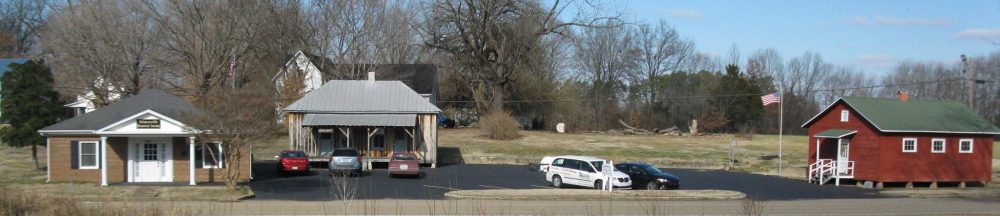
Even though I am a Palmersville native and as a teenager had lived within a ghost’s breath of the little family cemetery plot where several members of the Palmer family are interred, I knew very little about the Palmer family until the “genealogy bug” bit me. As most genealogists will agree it is almost impossible to research genealogy without also gaining knowledge of the area’s local history.
One of the earliest settlers to the area which was to become the village of Palmersville was Smith Palmer who was born in Virginia in 1790, the son of Amasa Palmer. Smith Palmer, accompanied by his nephew Edmund Mayfield Palmer, made the journey overland from North Carolina with teams and wagons and arrived in western Tennessee at a time when all the country was sparsely settled and only a few clearings were made in the great wilderness.
Edmund Mayfield Palmer settled near Paris in Henry County, Tennessee and became a very successful grocer there. He later moved to Paducah, Kentucky and after a time returned to Paris when he spent his last days. It is not known whether Smith Palmer’s wife and family came with him initially or joined him at a later date, but I believe Smith Palmer settled in Henry County for a time as records show he paid taxes in 1827 in Henry County on 463 acres and seven slaves as well as one poll tax.
However, we find that in 1833 Smith Palmer purchased a 640 acre section and an adjoining 125 acre tract in Weakley County near the present site of Palmersville where his slaves cleared up and improved a large amount of land. Here he spent his last days. Smith Palmer died in 1840. The village of Palmersville was laid out near the center of the Palmer farm in the early 1840’s and the town was first named Palmerville (note spelling) in his honor. Postal service was established on September 20, 1847 with John W. Palmer, son of Smith Palmer, as postmaster.
Reportedly John W. Palmer was also the first merchant of the village. Postal service was discontinued in August of 1849. Then in July of 1850, service was reinstated with the name of Palmer’s Store, again with John W. Palmer as postmaster, followed by his brother James A. Palmer as postmaster from 1851-1855. For the next few years postal service was intermittent. Possibly mail service was out of “Black Oak” or “Elm Tree” until1874 when the post office was reinstated as Palmersville, the current spelling, with Joseph W. Wescoat as postmaster.
Smith Palmer and his first wife Elizabeth Mayfield Palmer had seven known children:
- William A. Palmer born about 1812
- James Alfred Palmer born about 1815
- Emily Palmer born about 1817
- John W. Palmer born about 1819
- Henry 0. Palmer born about 1822
- Mary Rebecca Ann Palmer born about 1824, and
- Elizabeth Catherine Palmer born 1828.
The first six children were born in North Carolina and Elizabeth Catherine was born in Tennessee.
After the death of his first wife, Smith Palmer married another woman named Elizabeth (maiden name unknown), and to this union was born
- Amanda Palmer in 1830
- Tennessee Palmer in 1834
- Virginia Palmer in 1836
- Edward M. Palmer in 1838, and
- Sarah Palmer in 1840.
Smith Palmer’s last will and testament written September 6, 1839 and probated April 1840 leaves his estate consisting of land and twenty-one slaves to his beloved wife Elizabeth and his children. Over the years, the land was sold off until only 235 acres of the original Smith Palmer land remained in the Palmer family in 1892. At that time, the four heirs of Robert Smith Palmer (son of James Alfred Palmer and grandson of Smith Palmer) and his widow Sophia Josephine Palmer divided that 235 acres.
Although the final resting place of Smith Palmer is not known for certain, the Palmer family graveyard located behind the northwest corner of the old brick “Herman Biggs” store building in Palmersville does contain monuments to several of the Palmer family members–a lasting tribute to this pioneer family. Many believe that Smith Palmer is also buried at this site. A recent discovery in the center of the cemetery of a carefully-placed brick border which had been covered with layers of soil for many years and which happens to surround an area just the size of a grave gives a great deal of credence to this theory. If only those graveyard ghosts could talk!
August 2002
 Palmersville Historical Society