by Nelda Rachels
In 1923 the Palmersville Fair showed off the community’s livestock, chickens, crops, and spirit. In 2000 the fair may lack the poultry and crops, but not its community spirit. That is the one thing the fair may still “crow” about.
From the lunchroom workers who prepare the day’s turkey and dressing dinner to the quilters who bring in their work for exhibit, volunteers and participants have long been the backbone of this community event. Some names keep cropping up year after year in the list of volunteers while some of us sit on our “laurels” after just two or three years of minimal effort. I “quit” years ago, but workers like Shirley Kemp keep on giving. One of the areas she’s given much to is the kitchen, the area I most avoid. In fact, I think those who serve the fair day meal should get the bluest blue ribbon of all, for they see little of the fair itself.
Shirley remembers when the women used to get together early during fair week to snap garden fresh greenbeans for the dinner (lunch, for you Yankees). Now, she happily reports that the beans come from a can. It takes approximately twenty turkeys, graciously donated by E. W. James, to feed the crowd which lines the school hallway for a five dollar all-you-can-eat plate of turkey and trimmings with homemade pie (Even I contributed a homemade chess pie nearly every year that my children were in school).
At one time, volunteers met at 6:00 a.m. the day of the fair to pull turkey off the bone. Now, the school cooks cook the turkey (and make the cornbread, etc.) on Friday and P.T.O officers and spouses pull the turkey on Friday night, the day before the fair. Other volunteers then work in the kitchen on the big day itself. Other changes include the price. In 1955, a plate, including coffee, cost 50 cents. In 1974, barbecue replaced the chicken or turkey and dressing affair. The next year saw a return to the traditional menu.
Exhibitors are also major contributors to the fair. If they don’t bring in the canned goods, photographs, antiques, sewing, or culinary items for judging, the fair suffers. In fact, the long running antiques, hobbies, canned goods, and field crop categories have already been cut due to a lack of entries. Of course, the loss of the high school meant no more FHA and FFA categories.
However, the elementary grades and junior high still have their exhibits and games. In 1923, children competed for prizes with their creative maps of Tennessee, complete with major railroads, counties, and rivers. Today, each grade has a different exhibit category. Judging these student exhibits may be one of the most difficult jobs of all. I remember judging the history exhibits (Popsicle stick log cabins, cornshuck teepees, cardboard tomahawks, etc.) for a fifth grade class one year. You feel as if you have some child’s self-esteem in your hands. Of course, every child is a winner, but only one gets the blue ribbon.
I couldn’t help, as I looked over the creations, remembering the year our daughter designed a three-foot tall totem pole from salt-flour dough, acrylic paints, and a cardboard tube. She worked every weekend of September on it and didn’t get so much as an honorable mention. Another year, our son–who worked hard, but less than 2 hours on a teepee (original, of course)–won a blue ribbon. These examples only prove, I guess, that all judging is arbitrary, and difficult at best.
Well, one of the 1999 blue-prize winners, nine-year-old Tyler Adkins, certainly worked hard on his map of the United States for Mrs. Carol Bowlin’s third grade category of “Best U.S.A. Map.” He says he spent four days working “off and on” on his project. All seventeen class members, of course, were prizewinners because each one, as evidenced in the multicolored maps hanging in the hallway, had put forth his or her best effort.
Other fair efforts have come and gone or changed significantly in the P.T.O.’s creative attempts to help the fair grow and prosper: the cross-cut saw and wood chopping contests came and went in the late 70s; the Ruritan-sponsored tractor pull of ’76 and Antique Car category of ’77 and ’78 came back to life in the late ’90s; a steam and tractor show revitalized the fair in the late ’90s; Fairest of the Fair competition changed from its traditional Saturday afternoon time-frame to Friday night in the late 80s; the school play (in existence since 1923 when local talent played in Dust of the Earth) moved to another week entirely; Webb School dedication and Thompson School reunion held in 1996; Arts and Crafts booths added in ’88; money prizes won instead of store gifts; etc.
The P.T.O. sponsors the fair and uses the money made to benefit the school. In 1968, for instance, the P.T.O. bought 12 air conditioners, most from Sears Roebuck, so that every classroom would at last have one. Community spirited PTO members installed them. The P.T.O. has helped with everything from teacher requests for additional books and computer software to the renovation of bathrooms.
And what happens if Palmersville undergoes further changes, for instance the loss of its elementary school due to declining enrollment? What happens if or when there is no longer a school filled with children and, therefore, a need for the Palmersville P.T.O? I think it can do what Sidonia has done in recent years. Though it lost its school in the early sixties, it has recently begun using its old school grounds for an annual Sidonia Homecoming where the community still gets together to eat, converse, watch a parade, and raise money for its needs. Palmersville, too, may change–as its fair has over the years–but its community spirit doesn’t have to.
Sources: Shirley Kemp, Glenda Staples, Hubert Smethwick, and Tyler Adkins, who shared their memories; Cindy Stephens and Vickie Rook, who shared the P.T.O Minutes; and The Dresden Enterprise and The Weakley County Press, from which I gleaned old fair ads and articles. This article about the Palmersville fair originally appeared in the September, 2000 issue of Hometown magazine.
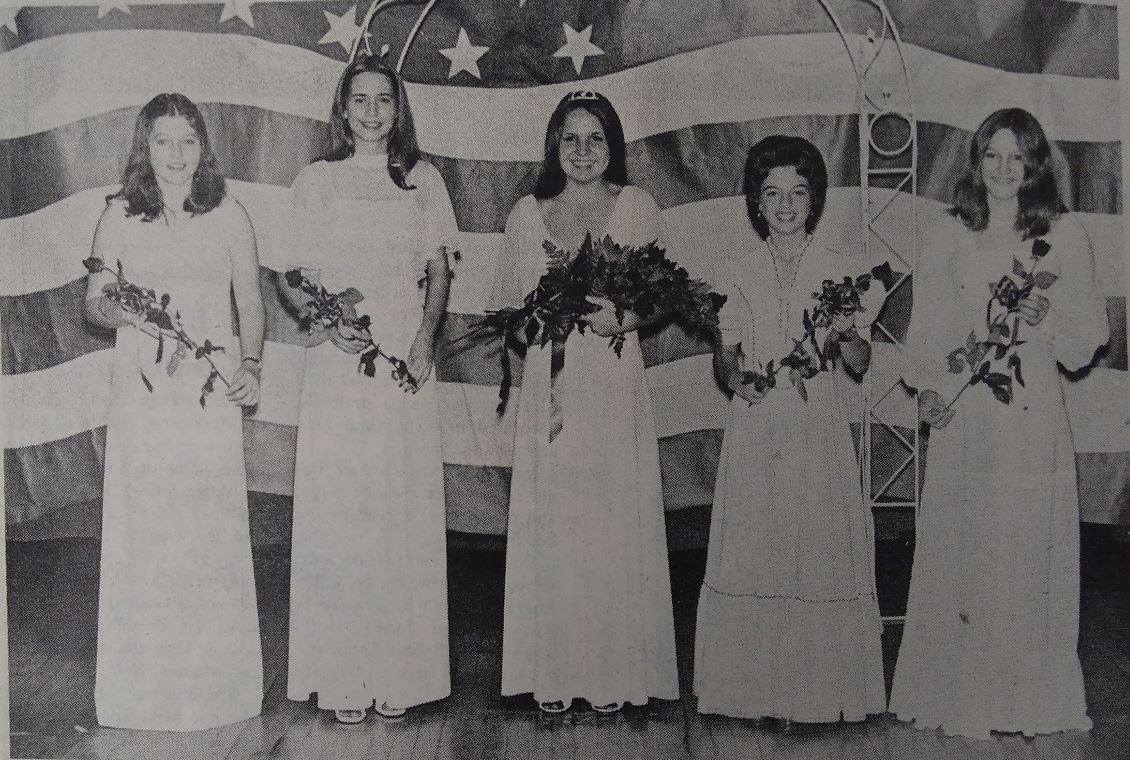 On Saturday Sept 27, 1975 Miss Sherry Glison was crowned Miss Fairest of the Fair at the Palmersville Community Fair.
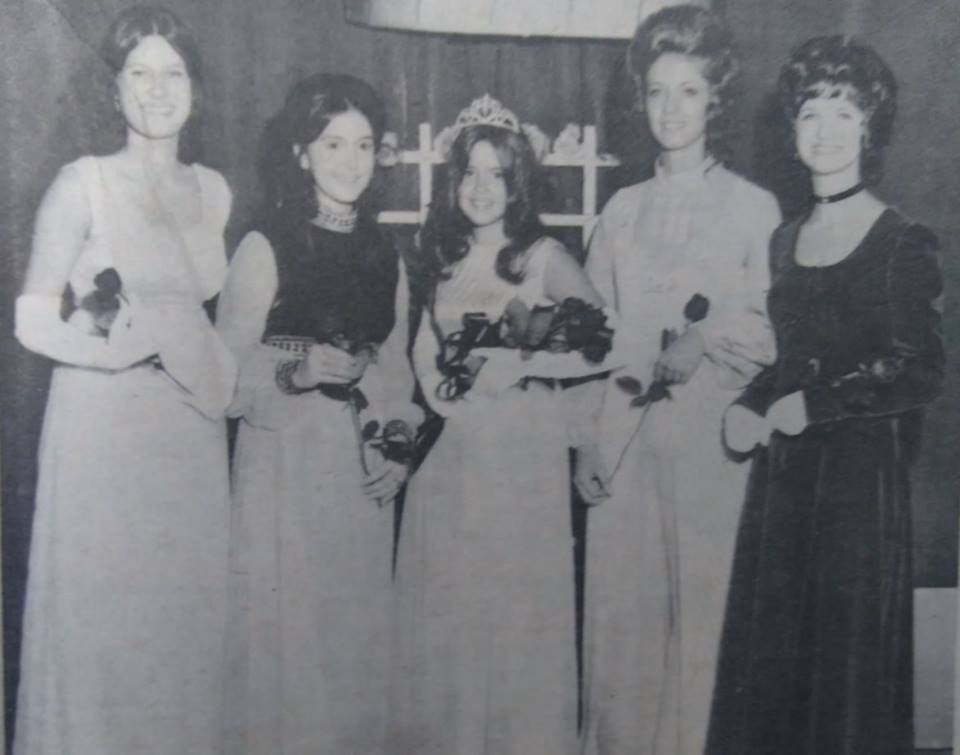 “Fairest of the Fair” court of the 45th Annual Palmersville Community Fair held Sept, 30th 1972.
  Palmersville Historical Society