1967 Baby Show Winners

Seen are the 1967 Palmersville Community Fair baby show winners and mothers

(front row L-R) Tracey Fagan and Mrs. Howard Fagan, Randy Ray and Mrs. Tommy Ray, Freda Kay Mansfield and Mrs. Kay Mansfield and Shon Randolph and Mrs. Jim Randolph

(back row L-R) Dale Leo and Mrs. Johnny Leo, Brent Montgomery and Mrs. Robin Montgomery, Danny Jo Mansfield and Mrs. Dan Mansfield and Melissa McClain and Mrs. Richard (Ricky) McClain

Courtesy of the Dresden Enterprise

Thanks to Robert G Reynolds of Palmersville, TN

Weakley County Map – Stouts Store, Austin Springs, and Fancy

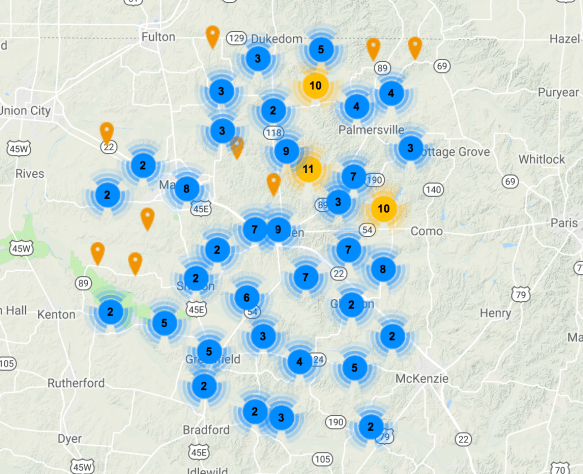
We’ve just discovered a good tool for exploring the Palmersville area.

Three maps of Weakley County are on this one site: topographic, satellite, and road.

Each balloon on the map is a place of interest, many of them are historical. For instance, you can find the locations of Williams Store, Stouts Store, Austin Springs, and Fancy.

Click on the map above to get started exploring.

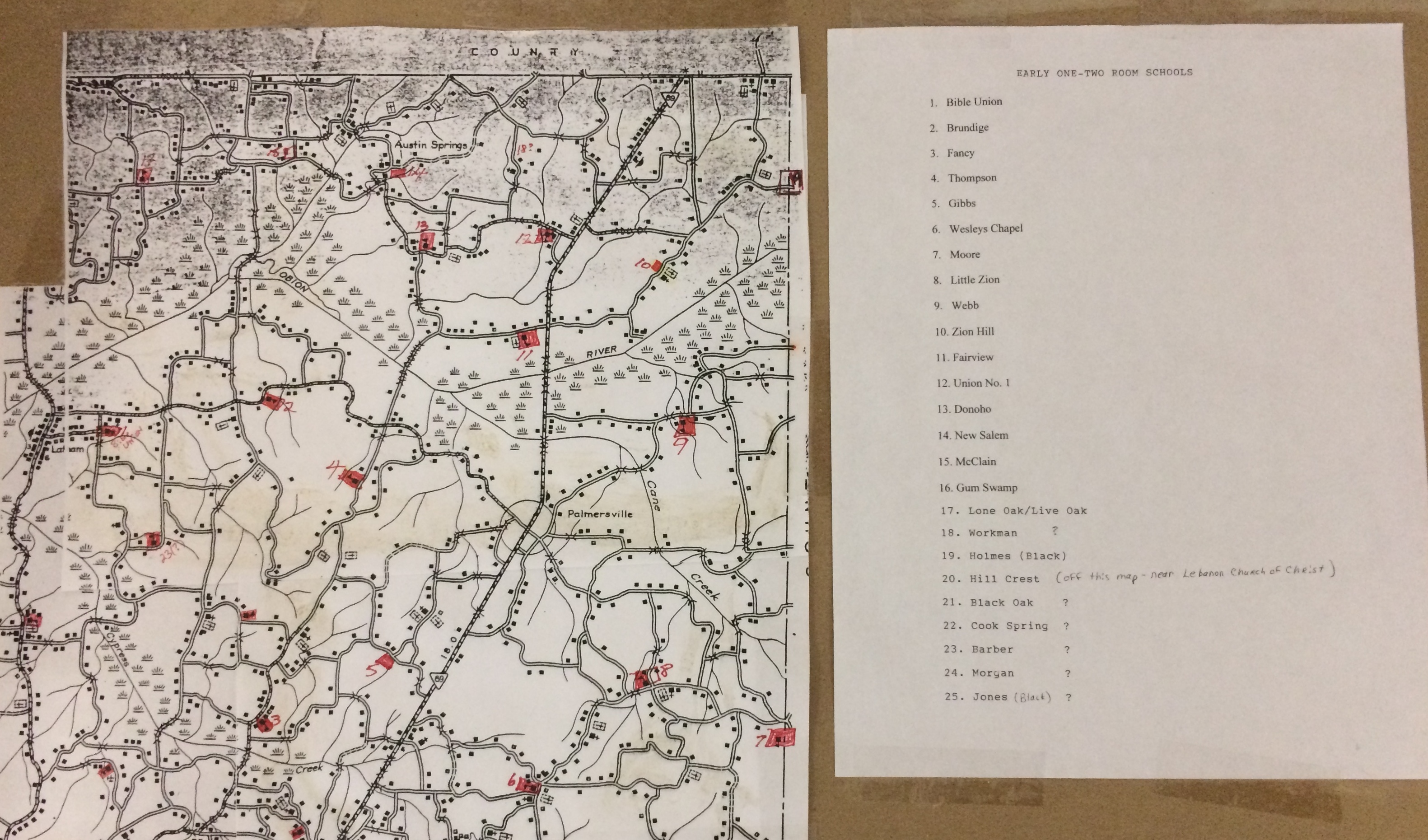
Early One/Two Room Schools

Goodness, there were a lot of schoolhouses back in the day – – – –

(click on the picture to get a larger view)

Schools listed are:

  1. Bible Union
  2. Brundige
  3. Fancy
  4. Thompson
  5. Gibbs
  6. Wesleys Chapel
  7. Moore
  8. Little Zion
  9. Webb
  10. Zion Hill
  11. Fairview
  12. Union No. 1
  13. Donoho
  14. New Salem
  15. McClain
  16. Gum Swamp
  17. Lone Oak / Live Oak
  18. Workman (?)
  19. Holmes (Black)
  20. Hill Crest
  21. Black Oak (?)
  22. Cook Spring (?)
  23. Barber (?)
  24. Morgan (?)
  25. Jones (Black) (?)

Mule Story

by Ben Cantrell

NELL AND WILLIAM FAULKNER

Jim Cantrell’s “mule story” in the last edition of the PHS newsletter reminded me of another story of ours that illustrates the peculiar nature of mules.

First, let me tell you how William Faulkner got into this narrative.  In his 1962 novel, The Rievers, one of the characters is a mule that loves sardines.  He can outrun any other mule if he thinks a sardine treat awaits him at the finish line; otherwise, like mules in general, he cannot be commanded to run anywhere in a straight line.  He dies–unbeaten–at age twenty-two.

In explaining how exceptional that particular mule is, Faulkner reckons that in general, a mule is second only to a rat as the most intelligent animal on the planet.  The rat comes in first because it lives with you and eats your food without making any contribution of his own, while a mule can be persuaded to work, but only within his own self-set limits.  In summing up what makes a mule so unique, Faulkner says:

“He will not permit himself to eat too much.  He will draw a wagon or a plow, but he will not run a race.  He will not try to jump anything he does not indubitably know beforehand he can jump; he will not enter any place unless he knows of his own knowledge what is on the other side; he will work for you patiently for ten years for the chance to kick you once.”

–The Rievers, Vintage Books Edition, p. 123

Well, I already knew a lot of that, just from growing up in the country.  Brother Bob always said a mule won’t get into a spot where he might get hurt.  He’s too smart for that.  And mules have many talents that they don’t want you to notice except as they are pleased to reveal them.  That’s where Nell enters the story.

Nell was half of a team of female mules that worked on our farm.   In the course of time, her team-mate Old Ader became lame in her left hind leg, making her limp badly when she walked on hard ground.  So Dad sold Old Ader to a neighbor who used her mainly to plow gardens, where she did fairly well.

That left Nell without a team-mate; her only companions were the log horses that worked in the woods.  And Nell didn’t like solitude.  She went wherever the horses went.

One day, the log team was driven to the woods in the Cane Creek bottom about three miles away, up close to Little Zion.  Dad told us to keep Nell in her stall until the horses were out of sight.  He thought she would be all right then.

But Nell was not fooled.  She began pawing at her stall door as soon as she knew what was going on.  She kept up a fuss, braying and snorting until we thought the team was far enough away.  Since we thought the coast was clear, we opened her stall door.  She bolted out, looking wild, and set out to find her companions.  First, she ran down to the sawmill, but the wire gap was closed so she couldn’t get out on the road.  Then, she ran back up the fence until she decided she had wasted enough time, so she simply jumped the fence as gracefully as a deer.

Then she ran up the road toward Palmersville, with her nose to the ground, like a bloodhound.  When she reached the crossroads, she had three choices:  straight, left, or right.  But she never hesitated.  She rounded the corner to her left at a full gallop and sped up past the Church of Christ, over the hill and past the cemetery (never doubting that she was on the right track).  She crossed the Cub Branch in record time and finally caught up with the horses at about the Mount Pentecost Place, where she fell into stride alongside the team and went on to the woods with them.

The rest of the day, Nell never let the horses out of her sight.  Each trip the horses made to snake a log out to the loading area, Nell went with them.  When they rested, so did she; when they were watered at a big spring nearby, she drank with them.  She didn’t get in the way; she was too smart for that–but she was never far away.

So, I already knew a lot about what Faulkner described in his book.  I realized that Nell could have been anything she wished.  She could have been a great coon hunter, but I suspect she thought running through the woods at night, trying to run another animal up a tree was ridiculous.  She could have been a great steeplechase runner too, but, to her, jumping over hedges might have seemed too dangerous since she could not see what was on the other side.  She was content just to be a mule until circumstances demanded that she use her extraordinary talents to accomplish something that she wanted to do.

Moral of the story:  Never underestimate a mule!

Ben’s challenge:  “This story is not unique; I’ll bet that all of you who grew up in the country have a “mule story” of your own.  Send them in and we’ll create a mule library at the Palmersville Historical Society.”