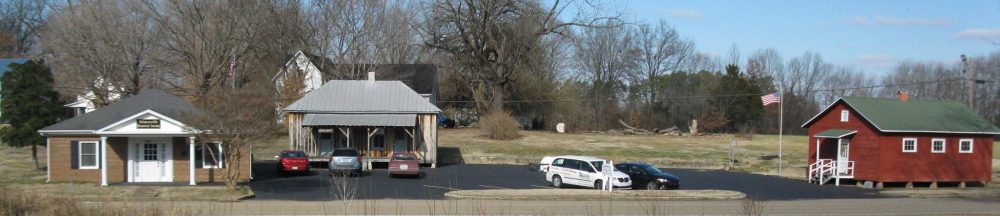
Lessons Learned from a Palmersville Legend

By Nelda Rachels (first published in Hometown magazine)

In 1975, I was fortunate to move to Palmersville, just up the hill from Opal Mayo and her husband, Irvin.

Soon, I was pulling my two young children in their little red Flyer down the road to her farmhouse for occasional visits.  Mr. Mayo would die soon after this, but I would get to know well “Mrs. Opal,” a woman of near legendary proportions, who lived in or near the Palmersville community from 1906 to 1987.  It was at her home that I learned the lessons of hospitality, frugality, and piety, which were hallmarks of her character.

Like most women of her generation, she immediately wanted to ply my children and I with food or drink the moment we entered her home.  She would have, proverbially speaking, killed the fatted calf to fulfill her notion of hospitality.  However, there was never any need for such extreme measures because her larder was always full.  So one of the first lessons she taught (and the hardest to learn) was to prepare ahead for visitors.  I learned that everything she’d prepared had been made in the time-honored fashion (by scratch) and that she often made her pies, cookies, and cakes in multiples so that not a bit of oven heat would be wasted.

That frugality, to utilize every kilowatt, may be the most legendary aspect of her character and perhaps the one I most admire in this age of excess.  The old adage, “Use it up, wear it out, make it do, or do without,” was her life’s motto.  I think because she’d grown up during hard times, she knew that what you had today could be gone tomorrow.  I remember the day she dug up some of her Red Emperor tulip bulbs to share with me.  She saw me looking at her shovel, its edge worn away to resemble the eastern border of Tennessee.

“Maybe you think I need a new one,” she said, laughing.  “Irvin used it settin’ trees while he was in the CCC during the Depression, but it’s not so worn out that it can’t dig up a few tulips yet.”

Mrs. Opal’s piety was also legendary.  She attended the Palmersville Church of Christ and never missed a service that I remember.  Even when she was actually “unable” to drive, she drove to church anyway, too independent and strong-willed to ask anyone for a lift.  And despite a lifetime of listening to sermons, I think she rarely let her mind wander because she always took notes on every sermon in a  tenographer’s notepad.  In addition, she never engaged in gossip, read her Bible “religiously,” and filled a large block calendar with information as to meeting times, preachers, and VBS dates.

Those yearly calendars also held information as to visitors, events, and weather.  Once, I glimpsed a stack of yellowing calendars in an upstairs room.  I’m sure one of them held information about the Dust Bowl years, the time when she bought one of her few cans of “store-boughten” corn.

I guess I was a bit disappointed when no auction was held after Mrs. Opal’s death.  I only wanted to bid on that shovel, which, for me, most represented Mrs. Opal’s history and character.  I’d be tempted to hang it near my mantel as a testament to her life. However, I think she’d be more pleased if I used it. No doubt, she’d say there is life in that old shovel yet.

Obion River and More

Our quarterly meeting was held Friday night, July 31, 2015 at 7:00 pm at our building. Dr. Hugh Berryman was the guest speaker for the program. He spoke about the geological makeup around the Palmersville area.

On Saturday August 1st, the Historical Society sponsored another “Canoe Float down the North Fork of the Obion River.” We met at the parking lot of the Historical Society building at 10:00 a.m. and then departed to the Sprouts Levee bridge for departure at 10:30 and floated to the Latham bridge. We had some additional information about the history of this section of the river including the swamp, logging, sawmilling, shingle making, old cypress hole, and the Byars-Bowlin-Watts water mill. Also the foundation of a third large building of the Lochridge Mill complex has been exposed by recent floods.

Cleaning of the historic portraits of early Palmersville area citizens who were members of the Masonic Lodge from the 1870s and onward is finished. Reframing with acid-free materials will soon be completed. We are grateful to the Lodge members for giving us the opportunity to preserve these portraits.

Recent Deaths of Palmersville graduates:

  • Anna Faye (Harrison) Hargrove, class of 1958
  • Jimmy Dale Puckett, class of 1962
  • Kerry L. Pentecost, class of 1969

Baseball after the War

Jim Cantrell submits this look back at community baseball in P’ville —

Between the late eighteen hundreds and the mid-nineteen sixties baseball was truly the American pastime. This was true in the Palmersville area, with many small communities having their own baseball team. During World War II these activities were no longer possible.

After the war teams were again organized in several communities. The make-up of the Palmersville team consisted mostly of players of the thirties and players of the late forties, with the occasional players from the twenties being available to pinch-hit.

In l947 Kuron Hooks and his wife Bernice had opened a general store with lunch counter in the old Willis Lee saloon building. Kuron had been a star catcher and heavy hitter on a team in some county South of Weakley County and wanted Palmersville to have a community team. We soon had a good local team and played teams organized at various times in Cuba, Ky., Dukedom, Latham, Dresden, Gleason, Huntingdon, Cottage Grove, Liberty, Midway, Skull Bone —— etc.

Kuron was our very capable catcher, with Ben Cantrell beginning to develop in the late forties and early fifties; later he was a catcher on Bethel College’s team. Keg Dawson was our star pitcher. He was in his mid thirties at the time and before World War II probably the best pitcher in Weakley County. Ruben Grubbs and Willy Griffith were also in their mid-thirties, very good pitchers, and were used in most of our games. Continue reading

Palmer Family Service Record

Ed Palmer
Company E. Enlisted September 17, 1863 at Paris, TN, by Capt. Bomer for 3 years. Bay horse valued at $600. Present on roll for March/April 1864. On roll for May/June 1864, “Transferred to old command May 23, 1864”.
Source: Compiled Service Records

E.H. Palmer
Company K. Enlisted January 1, 1864 at Conyersville, TN, by Capt. Bowman for the war. Black mule valued at $600. Present on roll for March/April 1864 as Private. Present on roll for May/June 1864 as 1st Sergeant, “Elected May 20th”. Wounded at Harrisburg.
Rennolds (1904/61) reports he died in hospital.
Died at Lauderdale Springs Confederate Hospital, September 12, 1864.
Source: Compiled Service Records [R]; Rennolds (1904/61); Watkins (1989), p. 30.

J.T. Palmer
Greer’s Regiment. Although filed with the Greer’s regiment cards, the labels appear to read “Green’s” regiment. On prisoner rolls: private, Co. A, captured at Waverly, TN, June 14, 1862; at Camp Douglas, IL, February, 1863; transferred to City Point, VA, April 1863.
Source: Compiled Service Records [G]

James Palmer
Company E. Enlisted November 25, 1863 at Paris, TN, by Capt. Bomer or Captain Hallum for 3 years. Bay mare valued at $600. Present on roll for March/April 1864. On roll for May/June 1864, “Transferred to old command May 23, 1864”. The file also contains a card stating that James Palmer was “wounded slightly left arm” at Tishomingo Creek; this card probably is misfiled.
Source: Compiled Service Records

Jesse Washington Palmer
Company E. The Index to Tennessee Confederate Pension Applications shows that Tennessee pension application #10669 was filed by Jesse W. Palmer of Carroll County for service with the 20th Cavalry.
Born 1844, Henry Co. TN. Married 1867, Martha Jane Ross, in Carroll Co. TN. Died 1920, Carroll Co. TN. Widow’s pension file #8015.
Source: Index to Tennessee Confederate Pension Applications; Sherril (1992)

Joseph Martin Palmer
Company E. Enlisted September 17, 1863 at Paris, TN, by Capt. Bomer for 3 years. Bay horse valued at $750. Present on roll for March/April 1864 as 2nd Sergeant. Present on roll for May/June 1864 as 2nd Sergeant. Wounded at Harrisburg. Oath of allegiance at Nashville, TN, May 23, 1865; described as resident of Henry Co., TN, fair complexion, light hair, blue eyes, 5 ft. 11 in., surrendered at Johnsonville, TN, May 20, 1865.
On report of absentees and deserters, Verona MS, Feb. 28, 1865. Residence Henry Co. TN; probable whereabouts Henry Co.
Born 1836, Henry Co. TN. Married 1855, Martha J. Faust, in Henry Co. TN. Died 1896, Gibson Co. TN. Widow’s pension file #4402.
Source: Compiled Service Records [R,C]; Sherril (1992); David Dyer

J.M. Palmer
Company E. Enlisted September 17, 1863 at Paris, TN, by Capt. Bomer for 3 years. Absent on roll for March/April 1864, “Absent with leave April 2, 1864”. Absent on roll for May/June 1864, “Absent without leave in Tenn. By Hallum”.
Source: Compiled Service Records [R]

from: http://www.utm.edu/staff/leeb/service.htm

Coley Gully

by Nelda Rachels

Some of us think of Palmersville’s once famous local landmark, Coley Gully, as the Grand Canyon in miniature, but then maybe those of us who have never actually seen the Grand Canyon are just easily impressed.   Perhaps at one long ago and ancient point in time, Coley Gully was much larger than it is now and under the ocean at that.  According to UTM Professor William McCutchen, this area was once part of the Gulf of Mexico.  He seemed happy to display his geological maps of sedimentary deposits and shelves showing the once-upon-a-time shoreline, which stretched as far north as Southern Illinois and as far east as the Tennessee River.  Gradually, the Gulf has been filling in with sediment, leaving the area as it is today.  In fact, on my visit fifteen years ago the Gully was much deeper and impressive than it is now.  Current landowners have sped the process of stopping the massive erosion problem and of filling in the Gully by planting pine seedlings.  These trees are now massive entities in themselves and are doing their job nicely…too nicely for those of us who like to explore big ditches.

On a recent visit to Coley Gully, I was struck by the beauty of the white sandy “beaches” in the gully’s depths.  Chickasaw and other area Indians probably admired that same sandy basin, perhaps using the sandstone rocks with their ironstone concretions at the gully’s bottom as color for facial or pictorial paintings.  McCutchen demonstrated this by licking his index finger, lightly touching the rock I had brought, and smearing his “dirty” finger casually across a bit of scrap paper.  The miracle of color—a pretty reddish brown—skated across the white page.

Jumping ahead a few hundred years to the 1930s and 40s, I’m told that Coley Gully at that time was the playground for another culture, teenagers of European descent.  Many of those same teenagers, though older now, still remember when Coley Gully was the “happenin’” place.  Hubert McKelvey, Hubert Smethwick, Mason Kemp, and other Palmersville residents shared a hodge-podge of memories about the area with me.

Hubert Smethwick remembers that school field trips and picnics were often held at Coley Gully.  He says students roasted marshmallows and hot dogs for picnics.  Other innocent fun included nighttime bonfires, storytelling, and sandstone rocks piled high and heated up in order to watch them explode like loud firecrackers.  Mason Kemp remembers that seniors usually went to Coley Gully in the latter part of the thirties but that Kentucky Lake took over as the field trip of choice by 1941.  However, Palmersville Seniors weren’t the only “jet-setters” to visit Coley Gully. Young people from all over West Tennessee and Kentucky knew about this big ditch and frequented it in their old Model Ts, or as Mr. McKelvey remembers—an old Studebaker.  Some of these visitors remember playing a game called “Perhaps.”   Young boys and men would slide down the steep sandy sides of the gully.  “Perhaps” they’d skin their bottoms or “perhaps” they wouldn’t.

Hubert McKelvey remembers sand in the pockets of teenagers and in the shovels of do-it-yourselfers that came to the gully to collect the lovely, pristine sand for mortar.    He also remembers the name of the owner from which the gully gets its name.  A man by the name of Coley (the spelling is in dispute by locals, though a deed search could settle that question once and for all) Adkins lived near the gully a bit before Mr. McKelvey’s time, perhaps during the early 1900s.  Mr. Adkins’ home was located between two gullies and near a stream.  Other locals hint at a moonshine still on the site (whether before, during, or after Coley Adkins’ lived there, no one seems to know) where whisky flowed perhaps swifter than the Gulf waters could swirl around those sandstone cliffs.  Today, it isn’t moonshine that residents nearby worry about, but the rumored big cat or panther that haunts the area, preying upon the sheep and cattle.

Pine trees now obscure the two gullies (only the larger one is “famous”) and their depths are not nearly as impressive as they were a few short years ago.  Teenagers now have their computer screens, fast cars, and bustling malls to keep them occupied though Mack’s Grove Baptist Church does go to Coley Gully for occasional cookouts.  They must not mind going to a little trouble.  These days, one must locate gracious property owners, ask for gate keys, climb boundary fences, fend off cows, ticks, and poison ivy, all while looking over one shoulder for that big cat.  It’s probably easier to get to the Grand Canyon.  I’ve heard it’s a really big ditch!

from http://www.utm.edu/staff/leeb/fair/gully.htm

Part II: The Rise and Decline of Austin Springs

by Nelda Rachels

A town never dies as long as there are people who remember it, and people who are willing to record and read about those memories.  Vivian Rickman, a Palmersville resident, remembers her visits to Austin Springs back when it was still a thriving community.

When Mrs. Rickman was a child, tourists were no longer coming for the healing effects of the mineral spring, but locals still went there to shop.  Mrs. Rickman says that going to the larger and farther away town of Dresden was a real treat, which usually only happened when relative Charlie Stephenson took her and her family in his Model T.  Since she lived at Fairview, only about five miles from Austin Springs, it was closer to go there in the family wagon.

George Harris owned one of the two general mercantile stores popular during Mrs. Rickman’s day.  The Johnson brothers, Clyde and Chap owned the other.   A 1931 article written by local correspondent Ela Frields mentions the Harris Brothers laying the foundation for a general merchandise store.  Residents remember it as being the larger of the two stores.  Mrs. Rickman liked buying a soda pop for five cents or buying clothes in the Harris store.  One year, her parents bought her a fur coat with shiny brass buttons. Sometimes the family would walk on the boardwalk over to Sam Dudley’s place to buy some healing salve.

Howard Harris, former postmaster at Dukedom and a relative of the now deceased George Harris, remembers that George had quite a sense of humor.  Mr. Harris told me this story: One day, a woman sent her child to George’s store to buy some sugar.  The sugar was in a barrel, so some had to be scooped out, weighed, and packaged.  As a joke, Harris packaged sand instead of sugar and sent it home by way of the child.  Later, the woman came back in with her “sugar” and stated that she had decided she didn’t want any sugar after all.  And before George could stop her, she had dumped her package of sand back into his barrel of sugar. The joke was on him!  Mr. Harris told other delightful tales on George.  It must have been a fun place to shop.  No wonder Mrs. Rickman liked to go there.

Ela Frields reported in a February 3, 1931 article in the Dresden Enterprise and Sharon Tribune that the Johnson General Store had been burglarized on the previous Sunday.  The thieves had stolen overalls, shirts, cigars, cigarettes, cheese, and money.  In this same article, Mrs. Frields reported that the old Austin Springs Hotel (mentioned in the last article) built “some forty years” before had burned down due to a kitchen flue fire.  By this time, tourists were no longer using the hotel as a place to stay.  The campground near the Springs, too, was no longer in use.  Instead, the hotel had been converted into a dwelling.  Luckily, the then current residents Dewey Ainley and family escaped and were later installed in Mrs. Lottie Cantrell’s tenant house.  Howard Harris remembers watching the hotel burn from a window of his home when he was just five years old.

There continued to be stores and businesses after the hotel’s burning.  Perhaps a “hall of fame” of a few of the former owners and residents should be remembered here.  Clarence Berryman, and later, Bant Hall, owned a blacksmith shop.  Carey Frields owned a sawmill, Charlie Vincent cut hair in 1946 for twenty-five cents, and George Harris and the Johnson Brothers owned the two mercantiles.  There was also a beer-joint, cream station, gristmill, switchboard, and probably several other businesses.  There was also a string band consisting of Carey Frields and Charlie Vincent, violinists; Delmas Copeland and Bant Hall, guitarists; and Chap Johnson on harmonica.  Other early residents of the area had last names like Acree, Murrell, Austin, McGuire, Bynum, Dunn, Gargis, Farmer, and Stunson.

The Decline of Austin Springs probably began when the last tourist came and put his or her jug down into the spring.  After that, the decline was steady.  With the advent of cars and the ensuing mobility, small towns could no longer compete with larger nearby towns that had better buying and job opportunities for the public.  One by one the stores and businesses dwindled away as the population began traveling away to do their shopping elsewhere.  In addition, as Mrs. Rickman said, “The people just faded away and so did the town.”

Even the mineral spring is no longer there.  It is buried somewhere under the bridge structure nearby. Community members remember that the highway department reworked the road and bridge several years back and covered it up.  Some still aren’t happy about that event.  Even the road, which cut through the main part of town, is no longer there.  Only the trail in tall grass marks the spot where Mrs. Rickman used to walk the boardwalk to Sam Dudley’s place.  However, there are still several homes clustered nearby, along with an empty store, built in the sixties.  Austin Springs may have declined from what it once was, but it hasn’t fallen.  The community still exists in the people who live there and in the memories they share about the past.

Read Part I here.

from http://www.utm.edu/staff/leeb/Austin%20Springs/Part%20I.htm

Part I: The Rise of Austin Springs

by Nelda Rachels (First published in Hometown)

The obsessions, the history, the survival of any small town usually depend somewhat on the total national or world picture. Somehow, the fevered obsessions of a nation can settle in even the smallest of its communities. One such fever was the 1800s health-craze for mineral water. The obsession for a health cure for ailments as diverse as female weakness, arthritis, gout, neuralgia, stomach upset, and asthma spread from Saratoga Springs in New York to Ojo Caliente Springs in New Mexico and all points in between, including Northwest Tennessee’s Austin Springs, located in the first district of Weakley County.

It’s hard to say how or where this fever started, but somewhere, someone decided that mineral water could cure almost anything. In fact, springs had long been sacred places of healing for Native Americans. In the early 1800s, many doctors, not a few quacks, and several real estate developers touted the mineral water cure through newspaper advertisements, brochures, and word-of-mouth.

Springs of all types were able to lay claim to cures from the ensuing testimonials of “cured” visitors no matter the type of mineral contained in the waters.  Most springs contained either salt, silica, sulphur, potassium, iron, manganese, alum, iodide, etc., or a combination of several of these elements.  As these springs became crowded with visitors (which increased with rail travel), the social aspects of the visit may have had as curative an effect on visitors (perhaps more so) than the waters themselves. Eventually, what would later become known as Austin Springs also attracted a heavy volume of tourists.

It’s difficult to say when the spring first became an attraction; however, by piecing together oral histories of the locals with newspaper accounts and Virginia C. Vaughan’s book, Weakley County, we can safely place the timeframe in the latter 1800s when Christopher Columbus Austin (better known as Chris), a farmer, owned land on Powell Creek. When Chris discovered a mineral spring on the creek’s bank, he walled it in with stone or brick curbing.

How people found out about the spring is a mystery, but by about 1888 the community sported a hotel to accommodate the many tourists who came for the spring’s healing effects. And rail travel did help. Oral histories from the community say that surreys full of visitors would come from the local train stations of Mayfield or Fulton. People who came in their own individual wagons would reside in tent cities in the campground set up near the spring; some stayed in the hotel, but all came with empty jugs to the spring’s mouth.

Most locals say that the spring water’s curative powers came from drinking it, not from bathing in it. It is likely, however, that a few folks drew up enough water to heat up and to bathe in because some felt that it took both methods to obtain the greatest benefit. Nearly everyone who has had personal knowledge of the water describe it as looking bad, smelling bad (like bad eggs), and tasting bad (like iron). It took a brave soul to drink it.

By 1889, Austin Springs had applied for a post office. Because there was already an Austin Springs, Tennessee, the post office took the name of “Unity.” The first postmaster was A.M. McQuire (1889-1893), followed by Aaron W. Duke (1893-1902) and David A. Frields (1902-1905). At various points in time, the town also contained general stores, a blacksmith shop, saloon, lock-up (jail), two gristmills, a cream station, barbershop, switchboard, restaurant, livery stable, sawmill, churches, and nearby schools. Tom Johnson built the first general merchandise store which his sons, Chap and Clyde, later continued to operate. Font Gibson (pronounced “Fount”) owned another. During the 1930s, George Harris, uncle to Howard Harris (who lives near Austin Springs and the source of much of my information), ran a general merchandise store, which contained groceries and millinery full of hats, shoes, and clothing.

Palmersville resident Vivian Rickman well remembers this store and how much she enjoyed shopping for clothes there.

Here is Part Two

from http://www.utm.edu/staff/leeb/Austin%20Springs/Part%20I.htm

Palmersville Man ‘Attacked’

From The Weakley County Press

November 1, 2001

Palmersville man ‘attacked’ by 600 gallon water bed mattress
By KAREN HELGESON

Staff Reporter

When James Cook of Palmersville opened his bedroom door last week, he received the shock of a lifetime his new waterbed mattress filled the entire room.

Cook began to fill up his new water bed mattress Monday, Oct. 22 and was driving into town when he suddenly remembered he had forgotten to turn off the water.

Rushing home to his trailer, he opened the bedroom door to find that the mattress now filled the entire room.  According to a Weakley County Sheriff’s Department report, Cook promptly called 911 to announce that the mattress was “about seven feet tall and much wider than the actual bed frame.”

Cook requested help from the fire department in bracing the sides of the bed, and said that if the mattress exploded, it would destroy the outside wall of his home.

Weakley County 911 in turn advised the Palmersville Fire Department that there was a 600-gallon water bomb inside Cook’s residence.

But before the PFD could respond, Cook called 911 a second time to report that the bed frame had just “exploded and collapsed.”  When the frame crumpled, several screws poked through the mattress, causing massive leaks.  The Cook family began to evacuate the trailer.

Minutes later, Cook called 911 a third time, stating that water was pouring from underneath the trailer, and that he believed the floor was going to give way.  Emergency dispatchers advised Cook to stand by until the fire department arrived.

PFD firefighters soon arrived shortly and they drained the mattress.

The home was not flooded, although the bed and bedroom were both damaged.

The Cook family was able to return the trailer that evening.

Palmersville Metorite

By WARREN DUZAK
The Tennessean
December 29, 2001

LEBANON – A space traveler the size of a volleyball landed in John Fagan’s tobacco patch in Palmersville, Tenn., one night in 1908 and eventually become a working member of the family.

The 20-pound stone served first as a curiosity as the ”the rock that fell out of the sky” and was hauled back to the Fagan house, where there was much speculation about its origins, said Hugh Berryman, Fagan’s grandson and a Wilson County resident.

The Fagans were practical folk, and the rock was eventually put to work as an anvil to crack hickory nuts and as a doormat particularly good for cleaning mud off one’s boots.

The stone graduated to become a driveway ornament and retired as a door stop before being inherited by Berryman several years ago.

Following a hunch, Berryman had the rock tested this summer, and the report came back positive. The 20-pound stone was not of this world, much less of Weakley County. It was, as Berryman had suspected and hoped, a meteorite.

More importantly, by the traditions of meteorite designations, its name will include the name of the post office nearest where it landed.

”I’m excited that Palmersville will be on the meteorite list forever and always,” said Berryman, whose family still owns the farm where the meteorite was found.

Folks in Palmersville, population about 150, were delighted with the newfound fame.

”Anytime you get Palmersville in the news, you are doing a good thing,” Palmersville Postmaster Robbie Perkins observed.

Berryman is one of the town’s ”illustrious” citizens who has gone off and done well, said Palmersville resident Hubert Smethwick, 79.

Smethwick said he heard there had been ”quite a stir” when Fagan first found the rock.

Worldwide, about 2,000 new meteorites are found each year and are often utilized the way the Fagans used the Palmersville meteorite, said Christopher Goodmaster, a student at Middle Tennessee State University who
collects meteorites and who helped Berryman through the process of certification.

”Using one as a doorstop is pretty common, but to crack nuts and to clean boots, I don’t know any that have been used that way,” Goodmaster admitted.

Sold as-is, the meteorite is worth a ”couple of thousand” dollars, but sliced up it could fetch as much as $8,000, he said.

Goodmaster cut a slice out of Berryman’s rock and sent it to Alan Rubin, a geochemist and meteorite expert at the University of California-Los Angeles to confirm the rock’s origins.

Rubin said he analyzes about 30 meteorites each month and about as many of what he referred to as ”meteor-wrongs.” Most of the real meteorites are from collectors who have obtained them from the Sahara Desert in Africa or the Mojave Desert in the western U.S.

”Almost everything I get from the public is not a meteorite,” Rubin said. ”They are not meteorites. They are ‘meteor-wrongs.’ They are family heirlooms, but they are not meteorites.

”This is one of the rare cases where it is a family heirloom and a meteorite, so I was pleasantly surprised that it was genuine, given the story that it was found by his grandfather.”

Rubin said meteorites are valuable because they hold secrets that date back to the beginning of the universe.

”They are older that any earth rocks and were some of the first rocks created in the universe,” he said.

Berryman, a consulting forensic anthropologist, said he is uncertain what he will do with his grandfather’s find but he knows he will not sell it. The Palmersville meteorite now adorns a shelf in the Berryman home, free from
the hard duty it once was expected to do.

Besides the slice for the sample, there are a few man-made dings in the pitted, rust-colored surface. After surviving millions of years in space and a fiery collision with the earth’s atmosphere, the Palmers-ville meteorite may have changed the most in the hands of Berryman’s uncles, Marlon and Howard Fagan, then young boys with big curiosity.

”They took a hammer and beat off the corners to see if there was anything inside,” Berryman said.

from http://www.utm.edu/~leeb/meteorite.htm

Part II: The Palmersville Fair

by Nelda Rachels

In 1923 the Palmersville Fair showed off the community’s livestock, chickens, crops, and spirit. In 2000 the fair may lack the poultry and crops, but not its community spirit. That is the one thing the fair may still “crow” about.

From the lunchroom workers who prepare the day’s turkey and dressing dinner to the quilters who bring in their work for exhibit, volunteers and participants have long been the backbone of this community event. Some names keep cropping up year after year in the list of volunteers while some of us sit on our “laurels” after just two or three years of minimal effort. I “quit” years ago, but workers like Shirley Kemp keep on giving. One of the areas she’s given much to is the kitchen, the area I most avoid. In fact, I think those who serve the fair day meal should get the bluest blue ribbon of all, for they see little of the fair itself.

Shirley remembers when the women used to get together early during fair week to snap garden fresh greenbeans for the dinner (lunch, for you Yankees). Now, she happily reports that the beans come from a can. It takes approximately twenty turkeys, graciously donated by E. W. James, to feed the crowd which lines the school hallway for a five dollar all-you-can-eat plate of turkey and trimmings with homemade pie (Even I contributed a homemade chess pie nearly every year that my children were in school).

At one time, volunteers met at 6:00 a.m. the day of the fair to pull turkey off the bone. Now, the school cooks cook the turkey (and make the cornbread, etc.) on Friday and P.T.O officers and spouses pull the turkey on Friday night, the day before the fair. Other volunteers then work in the kitchen on the big day itself. Other changes include the price. In 1955, a plate, including coffee, cost 50 cents. In 1974, barbecue replaced the chicken or turkey and dressing affair. The next year saw a return to the traditional menu.

Exhibitors are also major contributors to the fair. If they don’t bring in the canned goods, photographs, antiques, sewing, or culinary items for judging, the fair suffers. In fact, the long running antiques, hobbies, canned goods, and field crop categories have already been cut due to a lack of entries. Of course, the loss of the high school meant no more FHA and FFA categories.

However, the elementary grades and junior high still have their exhibits and games. In 1923, children competed for prizes with their creative maps of Tennessee, complete with major railroads, counties, and rivers. Today, each grade has a different exhibit category.  Judging these student exhibits may be one of the most difficult jobs of all.  I remember judging the history exhibits (Popsicle stick log cabins, cornshuck teepees, cardboard tomahawks, etc.) for a fifth grade class one year.  You feel as if you have some child’s self-esteem in your hands. Of course, every child is a winner, but only one gets the blue ribbon.

I couldn’t help, as I looked over the creations, remembering the year our daughter designed a three-foot tall totem pole from salt-flour dough, acrylic paints, and a cardboard tube. She worked every weekend of September on it and didn’t get so much as an honorable mention. Another year, our son–who worked hard, but less than 2 hours on a teepee (original, of course)–won a blue ribbon. These examples only prove, I guess, that all judging is arbitrary, and difficult at best.

Well, one of the 1999 blue-prize winners, nine-year-old Tyler Adkins, certainly worked hard on his map of the United States for Mrs. Carol Bowlin’s third grade category of “Best U.S.A. Map.”  He says he spent four days working “off and on” on his project. All seventeen class members, of course, were prizewinners because each one, as evidenced in the multicolored maps hanging in the hallway, had put forth his or her best effort.

Other fair efforts have come and gone or changed significantly in the P.T.O.’s creative attempts to help the fair grow and prosper: the cross-cut saw and wood chopping contests came and went in the late 70s; the Ruritan-sponsored tractor pull of ’76 and Antique Car category of ’77 and ’78 came back to life in the late ’90s; a steam and tractor show revitalized the fair in the late ’90s; Fairest of the Fair competition changed from its traditional Saturday afternoon time-frame to Friday night in the late 80s; the school play (in existence since 1923 when local talent played in Dust of the Earth) moved to another week entirely; Webb School dedication and Thompson School reunion held in 1996; Arts and Crafts booths added in ’88; money prizes won instead of store gifts; etc.

The P.T.O. sponsors the fair and uses the money made to benefit the school. In 1968, for instance, the P.T.O. bought 12 air conditioners, most from Sears Roebuck, so that every classroom would at last have one. Community spirited PTO members installed them. The P.T.O. has helped with everything from teacher requests for additional books and computer software to the renovation of bathrooms.

And what happens if Palmersville undergoes further changes, for instance the loss of its elementary school due to declining enrollment? What happens if or when there is no longer a school filled with children and, therefore, a need for the Palmersville P.T.O? I think it can do what Sidonia has done in recent years. Though it lost its school in the early sixties, it has recently begun using its old school grounds for an annual Sidonia Homecoming where the community still gets together to eat, converse, watch a parade, and raise money for its needs.  Palmersville, too, may change–as its fair has over the years–but its community spirit doesn’t have to.

Sources: Shirley Kemp, Glenda Staples, Hubert Smethwick, and Tyler Adkins, who shared their memories; Cindy Stephens and Vickie Rook, who shared the P.T.O Minutes; and The Dresden Enterprise and The Weakley County Press, from which I gleaned old fair ads and articles.  This article about the Palmersville fair originally appeared in the September, 2000 issue of Hometown magazine.