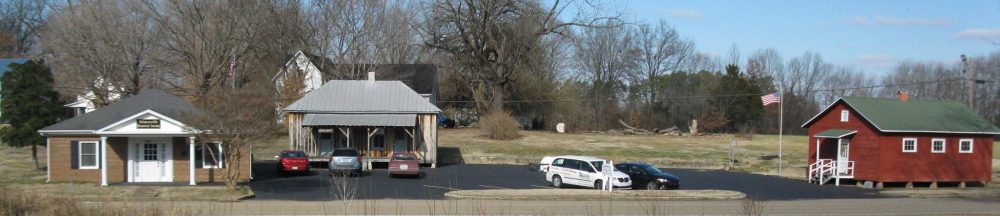
A Brief History of Latham

by Nelda Rachels (published formerly in Hometown, 2003)

Latham, like many small communities, has moved slightly from its original location in order to serve customers on a rerouted and busier highway.  Fortunately, the town’s main business area only had to move a few hundred yards to a rerouted Highway 118.

However, the greater mobility of the populace, the changes from a predominantly agricultural to an industrial economy, and the volume buying and cheaper prices of chain stores have all but killed the economic base of such communities in recent years.

The economic future looked much brighter in the 1850s when E.P. Latham settled in the area north of Dresden.  By the early 1900s, according to Virginia Vaughan’s text about about Weakley County’s history, Latham had at least two general stores, one owned by R. L. Stevens and another owned around 1919 by Winstead and Jones.  The Winstead and Jones store is said to have “sold everything from coffins to coffee.”  The drug store was run by Sam Winstead, who later managed the entire general store after his father had left the business.

During the 1920s Carlos Brundige operated a gristmill, sawmill, and general store.  Waterpower ran the gristmill while it served the community on the North Fork of the Obion River, but when the mill moved to Latham, it converted to steam power.  In addition there was a blacksmith shop and the early churches of Pisgah Methodist (organized in 1887) and Old Concord Baptist.  Later, the Calvary Missionary Baptist Church and the Church of Christ of Bible Union came to the community.

A small school by the name of Bible Union educated many students until 1955, after which it became a community center.  It was a long white wooden structure with a row of windows down its length.  Unfortunately, this historic building burned during the summer of 1999.  This tangible reminder of the community’s past, like much of any town’s history, now remains only in the memories and recollections of its people.

Life’s Greatest Lesson

By Nelda Rachels

(This story was first published in 2001 as the award-winning essay in Expressions from Home, a publication of the Weakley County Arts & Humanities Council. The essay had to be a very short 250 words, a very difficult assignment indeed! Ruth Rickman passed away just a few years after this essay was written, perhaps about 2004. Everyone misses her.)

My friend Ruth Rickman, who would soon turn ninety-five, needed someone to stay with her while she recuperated from pneumonia. I felt close to her, but I’d begun work on a book, and too much had already interrupted the writing. What if those two requested nights turned into four, five, or a month of nights? However, I knew the thoughts were selfish ones, so I put them away and stayed. I’m glad I did.

I’m afraid I’m a poor caretaker though. The first night I kept her up too late. She loved to talk about the old days, and since I’m a lover of history, I listened, enrapt. A question, such as, “Do you remember what year electricity came to Palmersville?”, netted the answer “1940” and the story of her young son who had died in ’39, how she had sat at his bedside waving a cardboard fan for days, and how it was too bad electricity hadn’t come a year earlier, when an electric fan could have relieved her feverish son.

She also told me the gruesome tale of a local man who had come to her grandfather’s store to buy fresh meat from a hog killed that frigid morning and how he’d left with the meat in his Model T but never made it home. He and his car drove off a levy and into a swamp. When the community searched and found him stiff and frozen near his car, they took his body to his widow’s house where they stood him in a corner to thaw.

Before I left that first morning—late, since we stayed up till 11:00 p.m. talking—she reached for my hand and pressed it with her own, blackened by the needles and tubes of her recent hospital stay. She thanked me for staying and said she loved me. I hugged her ninety-two pound frame. When she kissed me, I wondered why I had ever thought I was too busy to stay with her. Ruth had taught me the most valuable lesson of all: love is everything; take time to show it, for nothing, nothing else at all really matters.